Out to Launch
I'm off to Chincoteague, VA for the launch of a Minotaur Rocket carrying the NFIRE experimental satellite. All is 'GO' for launch early Monday morning.
Sunday, April 22, 2007

Wednesday, April 18, 2007
Victory for Life!!
The Supreme Court today upheld the federal ban on partial birth abortion. While this procedure represents only a small fraction of the total number of abortions, I believe that this ruling is significant. Seemingly modest reforms preceded the rapidly accelerating unraveling of the Soviet empire two decades ago. Expect a frantic counter-reaction by the cultural forces supporting abortion-on-demand, but let's pray and work for the day when every human life is protected.
Look for more reports and reaction at LifeNews.com and Pro-Life Blogs.
The Supreme Court today upheld the federal ban on partial birth abortion. While this procedure represents only a small fraction of the total number of abortions, I believe that this ruling is significant. Seemingly modest reforms preceded the rapidly accelerating unraveling of the Soviet empire two decades ago. Expect a frantic counter-reaction by the cultural forces supporting abortion-on-demand, but let's pray and work for the day when every human life is protected.
Look for more reports and reaction at LifeNews.com and Pro-Life Blogs.
An Act of Heroism
In every horrific event, we always hear of courageous acts by individuals which prevent even more deaths from occurring. At Virginia Tech on Monday, the actions of Professor Liviu Librescu, a 76 year-old Holocaust survivor who gave his life allowing several of his students to escape, stands out.
Mark Steyn and James Bowman wonder why this kind of heroic action is so rare. I don't know whether any of the others at Virginia Tech missed specific opportunities to thwart the maniacal killer, but these writers do raise a good question as to whether our western societies are ingraining passivity into their citizens, rather than encouraging heroic virtue like that of Professor Librescu and the passengers of United Flight 93.
In every horrific event, we always hear of courageous acts by individuals which prevent even more deaths from occurring. At Virginia Tech on Monday, the actions of Professor Liviu Librescu, a 76 year-old Holocaust survivor who gave his life allowing several of his students to escape, stands out.
Mark Steyn and James Bowman wonder why this kind of heroic action is so rare. I don't know whether any of the others at Virginia Tech missed specific opportunities to thwart the maniacal killer, but these writers do raise a good question as to whether our western societies are ingraining passivity into their citizens, rather than encouraging heroic virtue like that of Professor Librescu and the passengers of United Flight 93.
Monday, April 16, 2007
A Horrific Tragedy
The death toll of thirty-three human lives in today's Virginia Tech shooting massacre once again leaves people asking questions and groping for solutions. No doubt, there will be calls for more legislation of guns, etc. and more regimentation in student life. The real need is to go deeper into the conflicts in the human heart and not be afraid to seek spiritual solutions.
May Our Lord have mercy on the dead and injured, their families and friends, and on our society.
The death toll of thirty-three human lives in today's Virginia Tech shooting massacre once again leaves people asking questions and groping for solutions. No doubt, there will be calls for more legislation of guns, etc. and more regimentation in student life. The real need is to go deeper into the conflicts in the human heart and not be afraid to seek spiritual solutions.
May Our Lord have mercy on the dead and injured, their families and friends, and on our society.
Space Race
While Charles Simonyi continues to enjoy his trip as a paying customer staying at the international Space Station (ISS), his 'station-mate' Sunita Williams completed her participation in the Boston Marathon, far above the wind and rain that dogged the thousands of other participants.
Meanwhile, one final note on Yuri's Night. Keith Cowing describes his experience at the Yuri's Night celebration at NASA's Ames Research Center in Mountain View, CA and what it may mean for a changing relationship between the space community and society at large.
While Charles Simonyi continues to enjoy his trip as a paying customer staying at the international Space Station (ISS), his 'station-mate' Sunita Williams completed her participation in the Boston Marathon, far above the wind and rain that dogged the thousands of other participants.
Meanwhile, one final note on Yuri's Night. Keith Cowing describes his experience at the Yuri's Night celebration at NASA's Ames Research Center in Mountain View, CA and what it may mean for a changing relationship between the space community and society at large.
Yes the music was good, the lights and exhibits stimulating, and the crowd mellow and enthusiastic. But there was something more than sensual comfort operating.
There was an emergent property to all of this. I guess it at least had something to do with space exploration. But in many ways it was also about the future - the future of the future - and what it will be like to live there. In ever-increasing ways, our world is now poised on the cusp of what is and what will be. How that future is shaped is rushing at us at ever-increasing speed - and we all have our foot on the gas pedal.
Wednesday, April 11, 2007
When the Vodka-and-Tang is served,...

...it must be Yuri's Night! That's tomorrow. Yuri's night is celebrated around (and off) the planet to mark the anniversaries of Yuri Gagarin's pioneering orbital flight (1961) and of the first launch of the Space Shuttle (1981). (I'm planning to go to the DC event tomorrow night.)
UPDATE 4/12: Alan Boyle writes about today's Yuri's Night festivities.

...it must be Yuri's Night! That's tomorrow. Yuri's night is celebrated around (and off) the planet to mark the anniversaries of Yuri Gagarin's pioneering orbital flight (1961) and of the first launch of the Space Shuttle (1981). (I'm planning to go to the DC event tomorrow night.)
UPDATE 4/12: Alan Boyle writes about today's Yuri's Night festivities.
John McCain v. Conventional Wisdom
Senator John McCain spoke today (Hat Tip: NRO) at the Virginia Military Institute, urging perseverance with the new strategy in Iraq.
Senator McCain says it right. In hindsight, the war was badly mismanaged in the last four years, but the clock was reset with the implementation of the new strategy in January. And the consequences of giving up prematurely are frighteningly ominous.
Senator John McCain spoke today (Hat Tip: NRO) at the Virginia Military Institute, urging perseverance with the new strategy in Iraq.
These and other indicators of progress are encouraging, but they are not determinative. I understand the damage false optimism does to public patience and support. I learned long ago to be skeptical of official reports that are long on wishful thinking and short on substance. As we make progress in some areas, the enemy strikes where we do not have as great a presence. But security in the capital is indispensable to a greater level of security throughout the country so that political and economic progress can occur. And in Baghdad we are making progress. We have a long way to go, but for the first time in four years, we have a strategy that deals with how things really are in Iraq and not how we wish them to be.
Senator McCain says it right. In hindsight, the war was badly mismanaged in the last four years, but the clock was reset with the implementation of the new strategy in January. And the consequences of giving up prematurely are frighteningly ominous.
Stem Cell Vote Update
The US Senate today voted to pass both the bill funding embryonic (embryo destroying) research (but just shy of the margin required to override W's veto) and the bill funding ethical alternative research. Here are the roll call votes on the embryonic bill (S.5)and the ethical alternative bill (S.30).
Kudos to Senators Bob Casey of Pennsylvania and Ben Nelson of Nebraska, the only two Democrats to vote against S.5, the embryonic stem cell bill.
The US Senate today voted to pass both the bill funding embryonic (embryo destroying) research (but just shy of the margin required to override W's veto) and the bill funding ethical alternative research. Here are the roll call votes on the embryonic bill (S.5)and the ethical alternative bill (S.30).
Kudos to Senators Bob Casey of Pennsylvania and Ben Nelson of Nebraska, the only two Democrats to vote against S.5, the embryonic stem cell bill.
Tuesday, April 10, 2007
Space Enterprise Rising
While US billionaire entrepreneur Charles Simonyi has arrived at the International Space Station (ISS) with the Expedition 15 crew as a paying customer (i.e. space tourist), a couple of announcements today indicate more dramatic space business enterprise to come in the coming years.
Robert Bigelow has announced his ambitious business plan for his inflatable habitats in orbit and beyond. Meanwhile, SpaceDev has announced plans to collaborate with the United Launch Alliance (ULA) to study launch of its Dream Chaser reusable vehicle on the Atlas V booster. The space business world is getting more interesting all the time.
While US billionaire entrepreneur Charles Simonyi has arrived at the International Space Station (ISS) with the Expedition 15 crew as a paying customer (i.e. space tourist), a couple of announcements today indicate more dramatic space business enterprise to come in the coming years.
Robert Bigelow has announced his ambitious business plan for his inflatable habitats in orbit and beyond. Meanwhile, SpaceDev has announced plans to collaborate with the United Launch Alliance (ULA) to study launch of its Dream Chaser reusable vehicle on the Atlas V booster. The space business world is getting more interesting all the time.
Senate Debates Stem Cell Bills
The US Senate today began debate on bills setting the direction on funding for stem cell research, with votes set for tomorrow. President Bush has already promised a veto of the bill supporting research that would fund the destruction of human embryos, while saying he would support ethical and effective stem cell research.
Some additional good news: one Democratic senator appears to be following in the path of his late, great father, according to this report.
The US Senate today began debate on bills setting the direction on funding for stem cell research, with votes set for tomorrow. President Bush has already promised a veto of the bill supporting research that would fund the destruction of human embryos, while saying he would support ethical and effective stem cell research.
Some additional good news: one Democratic senator appears to be following in the path of his late, great father, according to this report.
"I have listened carefully, especially to those whose loved ones are suffering from serious diseases and disabilities and who disagree with my position," Casey said. "I deeply respect their views and hope they can come to understand mine."
Casey's position counters that of his Republican colleague, Pennsylvania Sen. Arlen Specter, who has been one of the Senate's most vocal supporters of embryonic stem cell research.
Circus on the Severn Folds Its Tent for 2007
The Maryland General Assembly has ended its 2007 session (none to soon). Here is a review from the Gazette newspaper and one from the Baltimore Sun. The articles note that some big issues, including the projected budget gap, were punted 'til next year.
The Maryland General Assembly has ended its 2007 session (none to soon). Here is a review from the Gazette newspaper and one from the Baltimore Sun. The articles note that some big issues, including the projected budget gap, were punted 'til next year.
Saturday, April 07, 2007
Have a Blessed and Happy Easter and Passover!
At daybreak on the first day of the week
the women who had come from Galilee with Jesus
took the spices they had prepared
and went to the tomb.
They found the stone rolled away from the tomb;
but when they entered,
they did not find the body of the Lord Jesus.
While they were puzzling over this, behold,
two men in dazzling garments appeared to them.
They were terrified and bowed their faces to the ground.
They said to them,
“Why do you seek the living one among the dead?
He is not here, but he has been raised.
Remember what he said to you while he was still in Galilee,
that the Son of Man must be handed over to sinners
and be crucified, and rise on the third day.”
And they remembered his words.
Then they returned from the tomb
and announced all these things to the eleven
and to all the others.
The women were Mary Magdalene, Joanna, and Mary the mother of James;
the others who accompanied them also told this to the apostles,
but their story seemed like nonsense
and they did not believe them.
But Peter got up and ran to the tomb,
bent down, and saw the burial cloths alone;
then he went home amazed at what had happened.
Lk 24:1-12
At daybreak on the first day of the week
the women who had come from Galilee with Jesus
took the spices they had prepared
and went to the tomb.
They found the stone rolled away from the tomb;
but when they entered,
they did not find the body of the Lord Jesus.
While they were puzzling over this, behold,
two men in dazzling garments appeared to them.
They were terrified and bowed their faces to the ground.
They said to them,
“Why do you seek the living one among the dead?
He is not here, but he has been raised.
Remember what he said to you while he was still in Galilee,
that the Son of Man must be handed over to sinners
and be crucified, and rise on the third day.”
And they remembered his words.
Then they returned from the tomb
and announced all these things to the eleven
and to all the others.
The women were Mary Magdalene, Joanna, and Mary the mother of James;
the others who accompanied them also told this to the apostles,
but their story seemed like nonsense
and they did not believe them.
But Peter got up and ran to the tomb,
bent down, and saw the burial cloths alone;
then he went home amazed at what had happened.
Lk 24:1-12
Thursday, April 05, 2007
"God comes to the rescue of our humanity"
George Weigel writes on the meaning of the Easter Triduum, which started this evening of Holy Thursday.
Weigel puts the headlines of our age in the context of this message of hope.
George Weigel writes on the meaning of the Easter Triduum, which started this evening of Holy Thursday.
The calendar pages turn, Lent unfolds — and once again, God comes to the rescue of our humanity. That is what we remember, ponder, and celebrate each year in the great Easter Triduum: the astonishing good news that the Creator of the universe entered his creation, in the person of his son, in order to redirect the story back to its proper end, which is eternal life within the light and love of the Blessed Trinity. That’s a rescue story for the ages.
Weigel puts the headlines of our age in the context of this message of hope.
The irrationality of the early twenty-first century is not only the irrationality of murder-in-the-name-of-God, however; it is also the irrationality of the radical skeptic, who insists that human beings can never know the truth of anything with surety. Corrosive skepticism is eating away at the cultural vitals of Europe, the continent that gave the world the very idea of reason; corrosive skepticism is not unknown in America, which is Europe transplanted. At this moment in history, confronted on the one side by irrational faith and on the other by a profound loss of faith in reason, the Church, Benedict XVI insists, must “make more room for rationality.”
For Spaceports, the 'Aye's Have It!
The Virginia Legislature, with the support of Governor Tim Kaine, has enacted legislation clarifying the liability regime for commercial human space travel, along with other supporting legislation for the Mid-Atlantic Regional Spaceport (MARS) at Wallops Island.
Meanwhile, it appears late today from provisional ballot counting that voters in Dona Ana County, New Mexico have narrowly passed a tax measure supporting the development of Spaceport America, that state's effort to take a leading role in the growing commercial human space travel industry.
The future is real, and may be coming to a spaceport near you.
The Virginia Legislature, with the support of Governor Tim Kaine, has enacted legislation clarifying the liability regime for commercial human space travel, along with other supporting legislation for the Mid-Atlantic Regional Spaceport (MARS) at Wallops Island.
Meanwhile, it appears late today from provisional ballot counting that voters in Dona Ana County, New Mexico have narrowly passed a tax measure supporting the development of Spaceport America, that state's effort to take a leading role in the growing commercial human space travel industry.
The future is real, and may be coming to a spaceport near you.
Monday, April 02, 2007
Remembering Pope John Paul II
Today is the second anniversary of the great Pope's passing to eternal life. JPII was known for his courageous advocacy of the defense of human life. Here is his Vatican web page of links.
A book I've just read, The President, the Pope, and the Prime Minister describes how JPII along with Ronald Reagan and Margaret Thatcher interacted to help bring about the end of the Cold War in freedom's favor.
Today is the second anniversary of the great Pope's passing to eternal life. JPII was known for his courageous advocacy of the defense of human life. Here is his Vatican web page of links.
A book I've just read, The President, the Pope, and the Prime Minister describes how JPII along with Ronald Reagan and Margaret Thatcher interacted to help bring about the end of the Cold War in freedom's favor.
Energy Savings Time - Not!
Apparently, the move to daylight savings time we made three weeks earlier was pretty much a draw in terms of energy savings, according to this Reuters report.
Actually I had my doubts about this measure when Congress was passing it two years year.
Apparently, the move to daylight savings time we made three weeks earlier was pretty much a draw in terms of energy savings, according to this Reuters report.
The move to turn the clocks forward by an hour on March 11 rather than the usual early April date was mandated by the U.S. government as an energy-saving effort.
But other than forcing millions of drowsy American workers and school children into the dark, wintry weather three weeks early, the move appears to have had little impact on power usage.
Actually I had my doubts about this measure when Congress was passing it two years year.
Friday, March 30, 2007
Remembering Terri Schindler-Schiavo
Tomorrow, March 31, is the second anniversary of Terri Schiavo's cruel death by judicial fiat. Her brother, Bobby Schindler, writes on the meaning of her life and death to our society.
How those terrible days leading up to Terri's death were covered by this blog can be reviewed by looking at my March 2005 archive.
Tomorrow, March 31, is the second anniversary of Terri Schiavo's cruel death by judicial fiat. Her brother, Bobby Schindler, writes on the meaning of her life and death to our society.
As hideous as it was, the truth is, long before Terri's case made headlines, the removal of basic care – food and water – was becoming commonplace. It continues to happen every day across our country oftentimes in cases, like Terri's, where the patient does not suffer from any life-threatening condition.
Much of the problem that exists stems from a blind acceptance of misinformation that has moved us from a firm belief in the sanctity of life to a "quality of life" mindset, which says that some lives are not worth living.
How those terrible days leading up to Terri's death were covered by this blog can be reviewed by looking at my March 2005 archive.
Thursday, March 29, 2007
The Bigger Picture
The increasing tenseness of the latest Iranian hostage crisis makes very timely, Victor Davis Hanson's article explaining that U.S. Involvement in Iraq is not to blame for terrorism and violence in other parts of the world and that an arbitrary withdrawal will not make it go away.
The increasing tenseness of the latest Iranian hostage crisis makes very timely, Victor Davis Hanson's article explaining that U.S. Involvement in Iraq is not to blame for terrorism and violence in other parts of the world and that an arbitrary withdrawal will not make it go away.
Should a peace candidate win the American presidency in 2008, prompting the U.S. to pull out of Iraq before the democracy there is stabilized, in the short term we will save lives and money. But as the larger war continues after we withdraw, jihadists will still flock to the Sunni Triangle. Hamas and Hezbollah will still rocket Israel. Syria will still kill Lebanese reformers. Iran will still try to cheat its way to a nuclear bomb. Ayman al- Zawahiri will still broadcast his al Qaeda threats from safety in nuclear Pakistan. The oil-rich, illegitimate Gulf sheikdoms will still make secret concessions and bribe increasingly confident terrorists to leave them alone. And jihadists will still try to sneak into the United States to kill us.
Joe Lieberman Says No to Dems' Legislating on Iraq Strategy
Senator Joe Lieberman, the Independent Democrat from Connecticut, says the deadline that Congress wants to impose on the U.S. actions in Iraq is "arbitrary and inflexible".
Joe Lieberman's independent streak (at least on national security issues) is a blessing to our country at this critical time.
Senator Joe Lieberman, the Independent Democrat from Connecticut, says the deadline that Congress wants to impose on the U.S. actions in Iraq is "arbitrary and inflexible".
Amazingly, however, just at the moment things are at last beginning to look up in Iraq, a narrow majority in Congress has decided that it's time to force our military to retreat. Rather than supporting Gen. Petraeus, they are threatening to strip him of the troops he says he needs and sabotage his strategy.
Joe Lieberman's independent streak (at least on national security issues) is a blessing to our country at this critical time.
Thursday, March 22, 2007
Falcon Launch 'Partial Success'
The SpaceX Falcon 1 launch took place on Tuesday. SpaceX claimed 95% of the test's objectives were met even though the test payload did not achieve orbit. The next launch is to orbit an actual customer's satellite, the Defense Department's TacSat 1.
The SpaceX Falcon 1 launch took place on Tuesday. SpaceX claimed 95% of the test's objectives were met even though the test payload did not achieve orbit. The next launch is to orbit an actual customer's satellite, the Defense Department's TacSat 1.
Sunday, March 18, 2007
Ready to Rumble
Space Exploration Technologies (SpaceX) is set to launch its Falcon 1, version 2 launch vehicle possibly as soon as tomorrow from Kwajalein Island in the Pacific. The rocket has been upgraded since a failed launch attempt a year ago. A successful launch will be another milestone in the emerging commercial space industry.
I'll be out of town for a few days, but check here for updates including information on a launch time, a possible webcast, and the (hopefully successful) outcome.
Space Exploration Technologies (SpaceX) is set to launch its Falcon 1, version 2 launch vehicle possibly as soon as tomorrow from Kwajalein Island in the Pacific. The rocket has been upgraded since a failed launch attempt a year ago. A successful launch will be another milestone in the emerging commercial space industry.
I'll be out of town for a few days, but check here for updates including information on a launch time, a possible webcast, and the (hopefully successful) outcome.
Saturday, March 17, 2007
Happy Saint Patrick's Day!
Artist unknown, Link by Catholic Forum
Catholic Forum provides descriptions of St. Patrick here and here.
Saint Patrick's Breastplate
Christ be with me, Christ within me,
Christ behind me, Christ before me,
Christ beside me, Christ to win me,
Christ to comfort me and restore me,
Christ beneath me, Christ above me,
Christ in quiet, Christ in danger,
Christ in hearts of all that love me,
Christ in mouth of friend and stranger.
In the spirit of the holiday, check out LiveIreland.com for webcasts of Irish music and other media direct from Ireland.
Artist unknown, Link by Catholic Forum
Catholic Forum provides descriptions of St. Patrick here and here.
Saint Patrick's Breastplate
Christ be with me, Christ within me,
Christ behind me, Christ before me,
Christ beside me, Christ to win me,
Christ to comfort me and restore me,
Christ beneath me, Christ above me,
Christ in quiet, Christ in danger,
Christ in hearts of all that love me,
Christ in mouth of friend and stranger.
In the spirit of the holiday, check out LiveIreland.com for webcasts of Irish music and other media direct from Ireland.
Saturday, March 10, 2007
Amazing Grace
Tonight I saw the movie Amazing Grace, which tells the story of William Wilberforce, the British MP who courageously led the fight to end the slave trade two centuries ago.
Wilberforce is an inspiration for those today who are fighting for the dignity of every human life against the appalling evils of abortion, embryo destruction, euthanasia, genocide, human trafficking, etc. A few blocks from the movie theatre in downtown Silver Spring where I saw the film is a Planned Parenthood abortion facility where I join others in prayer on the sidewalk on Saturday mornings, playing our small part in continuing Wilberforce's fight in today's society.
Tonight I saw the movie Amazing Grace, which tells the story of William Wilberforce, the British MP who courageously led the fight to end the slave trade two centuries ago.
Wilberforce is an inspiration for those today who are fighting for the dignity of every human life against the appalling evils of abortion, embryo destruction, euthanasia, genocide, human trafficking, etc. A few blocks from the movie theatre in downtown Silver Spring where I saw the film is a Planned Parenthood abortion facility where I join others in prayer on the sidewalk on Saturday mornings, playing our small part in continuing Wilberforce's fight in today's society.
Sunday, March 04, 2007
Taking the Hill
After today's training session, I'll be joining ~thirty volunteers tomorrow and Tuesday for this year's ProSpace March Storm Congressional briefings. This years agenda includes initiatives related to prizes, infrastructure, commercial transportation to the International Space Station (ISS), and focusing the Crew Exploration Vehicle (CEV) on the goals beyond Earth orbit.
After today's training session, I'll be joining ~thirty volunteers tomorrow and Tuesday for this year's ProSpace March Storm Congressional briefings. This years agenda includes initiatives related to prizes, infrastructure, commercial transportation to the International Space Station (ISS), and focusing the Crew Exploration Vehicle (CEV) on the goals beyond Earth orbit.
Iraq: Past and Future
Victor Davis Hanson writes at National Review Online, describing the mistakes made in executing the war in Iraq following the initial success in toppling Saddam Hussein's government, but argues that the outcome is not irrevocably lost.
Victor Davis Hanson writes at National Review Online, describing the mistakes made in executing the war in Iraq following the initial success in toppling Saddam Hussein's government, but argues that the outcome is not irrevocably lost.
But if we have an orphaned war that is dubbed lost, it nevertheless can still be won. None of our mistakes has been fatal; none is of a magnitude unprecedented in past wars; all have been cataloged; and few are now being repeated. We now understand the politics of our Iraqi odyssey, with all its triangulations, and the ruthlessness of our enemies.
Not arguments, rhetoric, pleading, or money right now can save the democracy in Iraq. The U.S. military alone, in the very little remaining time of this spring and summer, can give Iraqis the necessary window of security and confidence to govern and protect themselves, and thereby to allow the donors, peacekeepers, compromises, and conferences to follow.
Wednesday, February 28, 2007
By Jove!!

Jupiter's Little Red Spot Imaged by New Horizons Spacecraft
Credit: NASA/Johns Hopkins University Applied Physics Laboratory/Southwest Research Institute
The New Horizons spacecraft flew by Jupiter early this morning, picking up a gravity assist on its way to Pluto-and-beyond.
This evening some friends and I (after a stop for Mexican food and margaritas just outside the Lab) attended a Planetary Society sponsored event at the Johns Hopkins Applied Physics Laboratory, the organization which built and is now controlling the pioneering spacecraft. We heard one of the leading mission scientists present the history of the project and the latest results and images from the flyby.

Jupiter's Little Red Spot Imaged by New Horizons Spacecraft
Credit: NASA/Johns Hopkins University Applied Physics Laboratory/Southwest Research Institute
The New Horizons spacecraft flew by Jupiter early this morning, picking up a gravity assist on its way to Pluto-and-beyond.
This evening some friends and I (after a stop for Mexican food and margaritas just outside the Lab) attended a Planetary Society sponsored event at the Johns Hopkins Applied Physics Laboratory, the organization which built and is now controlling the pioneering spacecraft. We heard one of the leading mission scientists present the history of the project and the latest results and images from the flyby.
Sunday, February 25, 2007
Astronaut Farmer: the Dream and the Reality
I saw the movie Astronaut Farmer starring Billy Bob Thorton and Virginia Madsen last night. While it would be easy to pick out some technical inaccuracies and a plot that strains credibility, I recommend it as a fun and inspiring movie (mostly family friendly, aside from a few instances of profanity).
The story of a Texas rancher who builds a rocket and spacecraft in his barn evokes a 'New Space' spirit while hearkening back to a very retro spaceship design. Here are reviews by Alan Boyle and Rob Pearlman.
The idea of a non-governmental effort to put humans into space has already come to reality, at least at the level of suborbital spaceflight, with the 2004 flights of SpaceShipOne. And private enterprise space travel may soon be reaching much further, as described by this article in this week's Time magazine.
I saw the movie Astronaut Farmer starring Billy Bob Thorton and Virginia Madsen last night. While it would be easy to pick out some technical inaccuracies and a plot that strains credibility, I recommend it as a fun and inspiring movie (mostly family friendly, aside from a few instances of profanity).
The story of a Texas rancher who builds a rocket and spacecraft in his barn evokes a 'New Space' spirit while hearkening back to a very retro spaceship design. Here are reviews by Alan Boyle and Rob Pearlman.
The idea of a non-governmental effort to put humans into space has already come to reality, at least at the level of suborbital spaceflight, with the 2004 flights of SpaceShipOne. And private enterprise space travel may soon be reaching much further, as described by this article in this week's Time magazine.
Wednesday, February 21, 2007
Ash Wednesday
Today marks the start of the holy season of Lent, leading up to the joyous feast of Easter. Here is Pope Benedict XVI's Lenten message.
Also, here is a list of Lenten links from the Anchoress (Hat tip: Kathryn Jean Lopez).
Today marks the start of the holy season of Lent, leading up to the joyous feast of Easter. Here is Pope Benedict XVI's Lenten message.
May Lent be for every Christian a renewed experience of God's love given to us in Christ, a love that each day we, in turn, must "regive" to our neighbor, especially to the one who suffers most and is in need. Only in this way will we be able to participate fully in the joy of Easter.
Also, here is a list of Lenten links from the Anchoress (Hat tip: Kathryn Jean Lopez).
Tuesday, February 13, 2007
Too Much, Too Soon
When a political wonk like Karl Rove says the 2008 presidential campaign is getting revved up way too early for the candidates' own good, you know that things are getting out of hand.
When a political wonk like Karl Rove says the 2008 presidential campaign is getting revved up way too early for the candidates' own good, you know that things are getting out of hand.
"I think it is going to mean that people develop a persona earlier and wear out their welcome earlier than they would," he told The Politico in an interview. "I think there's going to come some point this year where people are going to basically be saying: 'I'm largely disinterested in the contest.' "
Believers, Deniers, and Skeptics
Ellen Goodman is sure about human activity causing warming of the global climate, and what she thinks of those who don't necessarily agree with her.
But Mark Steyn, in his witty way, describes some of the various scientific studies being published that draw a range of conclusions regarding the climate question, going beyond the over-simplification of the Media echo-chamber.
As I've said in an earlier post, scientific climate study must be vigorously pursued and developing alternative sources and more efficient use of energy makes sense on a number of grounds. However, when we're told that a question involving major economic and social policy implications is 'settled' and that no doubts are allowed, maybe that's a sign that some healthy skepticism is due.
BTW, Wednesday's House subcommittee hearing on "Climate Change: Are Greenhouse Gas Emissions from Human Activities Contributing to a Warming of the Planet?" has been postponed due to the snow & ice storm hitting this part of the country.
Ellen Goodman is sure about human activity causing warming of the global climate, and what she thinks of those who don't necessarily agree with her.
I would like to say we're at a point where global warming is impossible to deny. Let's just say that global warming deniers are now on a par with Holocaust deniers, though one denies the past and the other denies the present and future.
But Mark Steyn, in his witty way, describes some of the various scientific studies being published that draw a range of conclusions regarding the climate question, going beyond the over-simplification of the Media echo-chamber.
Are you thinking maybe it's time to turn over the page to the Anna Nicole Smith "A life in pictures" double spread? Well, that's my point. Most of us aren't reading the science, or even a precis of the science. We're just reading a constant din from the press that "the science is settled," and therefore we no longer need to think about it: The thinking has been done for us. Last week's U.N. IPCC "report," for example, is not the report, but a political summary thereof.
As I've said in an earlier post, scientific climate study must be vigorously pursued and developing alternative sources and more efficient use of energy makes sense on a number of grounds. However, when we're told that a question involving major economic and social policy implications is 'settled' and that no doubts are allowed, maybe that's a sign that some healthy skepticism is due.
BTW, Wednesday's House subcommittee hearing on "Climate Change: Are Greenhouse Gas Emissions from Human Activities Contributing to a Warming of the Planet?" has been postponed due to the snow & ice storm hitting this part of the country.
Thursday, February 08, 2007
Spectacular Galactic View

NASA/ESA/STScI/AURA
Here's a spectacular view of galaxies in the cluster Abell S0740 over 450 million light-years away in the direction of the constellation Centaurus. The image was taken by the now mostly non-functional Advanced Camera for Surveys (ACS) onboard the Hubble Space Telescope (HST).

NASA/ESA/STScI/AURA
Here's a spectacular view of galaxies in the cluster Abell S0740 over 450 million light-years away in the direction of the constellation Centaurus. The image was taken by the now mostly non-functional Advanced Camera for Surveys (ACS) onboard the Hubble Space Telescope (HST).
Astronaut Highs and Lows
So much has been written about the sorry turn of events involving astronaut Lisa Nowak. Summaries of article links are provided by SpaceToday.net and HobbySpace. All I can add is that we take the bad with the good within us wherever we go and bring it back home with us.
On the lighter side, Apollo 11 lunar pioneer Buzz Aldrin (who went through his own personal difficulties following his historic flight) appeared recently on a British TV talk show, showing he still has the 'right stuff' including a quick sense of humor. Here's the link to the YouTube clip (~9 minutes) (Hat tip to Pete Backus).
So much has been written about the sorry turn of events involving astronaut Lisa Nowak. Summaries of article links are provided by SpaceToday.net and HobbySpace. All I can add is that we take the bad with the good within us wherever we go and bring it back home with us.
On the lighter side, Apollo 11 lunar pioneer Buzz Aldrin (who went through his own personal difficulties following his historic flight) appeared recently on a British TV talk show, showing he still has the 'right stuff' including a quick sense of humor. Here's the link to the YouTube clip (~9 minutes) (Hat tip to Pete Backus).
Monday, February 05, 2007
Climate Debate Heats Up
Well, since we're going through some days with sub-freezing temperatures this week, it must be time to bring up the topic of climate change. The United Nations has released the first volume of the latest assessment of the Intergovernmental Panel on Climate Change. The policy summary (PDF file) states
Meanwhile, the editors at National Review Online comment that the IPCC has pulled back from some of the more dire conclusions of their 2001 assessment.
So an appropriate response to the question is somewhere between complacency with the status quo and a panic induced push toward economic restrictions and social engineering. Certainly, climate does change (warmer and cooler) over time, and the natural and human factors involved are not yet fully understood. Scientific efforts to monitor and analyze the situation must be sufficiently funded. And regardless of the actual impact of human activity on the global climate, practical measures to develop alternative energy sources and use the energy efficiently make sense from national security, economic, and general environmental grounds.
Well, since we're going through some days with sub-freezing temperatures this week, it must be time to bring up the topic of climate change. The United Nations has released the first volume of the latest assessment of the Intergovernmental Panel on Climate Change. The policy summary (PDF file) states
Global atmospheric concentrations of carbon dioxide, methane and nitrous oxide have increased markedly as a result of human activities since 1750 and now far exceed pre-industrial values determined from ice cores spanning many thousands of years (see Figure SPM-1). The global increases in carbon dioxide concentration are due primarily to fossil fuel use and land-use change, while those of methane and nitrous oxide are primarily due to agriculture. {2.3, 6.4, 7.3}
Meanwhile, the editors at National Review Online comment that the IPCC has pulled back from some of the more dire conclusions of their 2001 assessment.
Gone from the latest summary is the infamous “hockey stick” of the 2001 report. This was a graphic purporting to show that the planet is warmer today than at any time in the last thousand years, a demonstration which required erasing the inconvenient medieval warm period and the little ice age. The new IPCC report has also reduced its estimate of the human influence on warming by one-third (though this change was not flagged for the media, so few if any news accounts took notice of it). That reduction is one reason the IPCC narrowed the range of predicted future warming, and lowered the new midpoint — i.e., the most likely prediction of temperature increase — by a half degree, from 3.5 degrees Celsius in 2001 to 3 degrees in this report. The new assessment also cuts in half the range of predicted sea-level rise over the next century.
So an appropriate response to the question is somewhere between complacency with the status quo and a panic induced push toward economic restrictions and social engineering. Certainly, climate does change (warmer and cooler) over time, and the natural and human factors involved are not yet fully understood. Scientific efforts to monitor and analyze the situation must be sufficiently funded. And regardless of the actual impact of human activity on the global climate, practical measures to develop alternative energy sources and use the energy efficiently make sense from national security, economic, and general environmental grounds.
Federal Budget Day
President Bush sent the Administration's proposed Fiscal Year (FY) 2008 federal budget request to Congress today. Highlights include $145 billion for the Iraq and Afghanistan wars and projecting a balanced budget by FY 2012 while making tax cuts permanent. Needless to say, there is much debate about all of these provisions.
The FY 2008 request for NASA is $17.3 billion, a modest increase over last year's request, but a more significant increase over the FY 2007 level as it stands currently in the House, at $16.2 billion. That spending measure would have a serious impact on NASA programs, especially the development of the exploration vehicles planned to replace the Space Shuttle. Of course the congressional budget appropriation process is rather arcane, and the situation may be improved later in the year, but in the mean time this situation does complicate program planning. Here is Space.com's report.
Space organizations are weighing in on the budget issue. The Space Foundation says that even the Bush Administration request shortchanges the exploration effort, while the Space Frontier Foundation sees an opportunity in the proposed congressional cutbacks.
President Bush sent the Administration's proposed Fiscal Year (FY) 2008 federal budget request to Congress today. Highlights include $145 billion for the Iraq and Afghanistan wars and projecting a balanced budget by FY 2012 while making tax cuts permanent. Needless to say, there is much debate about all of these provisions.
The FY 2008 request for NASA is $17.3 billion, a modest increase over last year's request, but a more significant increase over the FY 2007 level as it stands currently in the House, at $16.2 billion. That spending measure would have a serious impact on NASA programs, especially the development of the exploration vehicles planned to replace the Space Shuttle. Of course the congressional budget appropriation process is rather arcane, and the situation may be improved later in the year, but in the mean time this situation does complicate program planning. Here is Space.com's report.
Space organizations are weighing in on the budget issue. The Space Foundation says that even the Bush Administration request shortchanges the exploration effort, while the Space Frontier Foundation sees an opportunity in the proposed congressional cutbacks.
Wednesday, January 31, 2007
Hubble Trouble and Zenit Zapped
The Hubble Space Telescope's main instrument, the Advanced Camera for Surveys (ACS) failed last Saturday and is unlikely to be returned to normal operations. The anomaly is under investigation, according to the NASA press release.
Meanwhile, a commercial launch went ary on its launch platform with the explosion of a SeaLaunch Zenit booster on Tuesday. Here's a YouTube video of the launch explosion.
The Hubble Space Telescope's main instrument, the Advanced Camera for Surveys (ACS) failed last Saturday and is unlikely to be returned to normal operations. The anomaly is under investigation, according to the NASA press release.
"It is too early to know what influences the ACS anomaly may have on Hubble Space
Telescope Servicing Mission-4 planning" said Preston Burch, associate
director/program manager for the Hubble Space Telescope. "It is important that
the review board conduct a thorough investigation that will allow us to
determine if there are any changes needed in the new instruments that will be
installed on the upcoming servicing mission so that we can be sure of maximizing
the telescope's scientific output. We are continuing to make excellent progress
in our preparations for the servicing mission, which is presently targeted to
fly in September 2008."
Meanwhile, a commercial launch went ary on its launch platform with the explosion of a SeaLaunch Zenit booster on Tuesday. Here's a YouTube video of the launch explosion.
Sunday, January 28, 2007
Here Now, the Infinite Space, Infinite God Virtual Book Tour

FINAL NOTE: Thank you Karina and Rob. Best wishes on the move and the Squadron Command in Minot ND and I look forward to hearing of the success of Infinite Space, Infinite God.

Today, I am doing something special here at Life at the Frontier. I am honored and privileged to be host an interview with Rob and Karina Fabian to talk about their anthology of science fiction that is filled with themes of the Catholic Faith, Infinite Space, Infinite God.
Rob and Karina Fabian met in the Air Force, but their love for science fiction (and for puns) brought them together. Karina is a cradle Catholic, and attending church with her introduced Rob to the beauty of the Catholic Mass. He instantly felt at home and was confirmed just before their wedding. They now have four children, Steven, Amber, Alex, and Liam.
Writing is one way they stay connected and share a passion that doesn't result in children. While on a "date," they dreamed up a near-future where mankind has colonized the solar system and an order of nuns dedicated to space search and rescue protects the intrepid spacers for "air, shelter and the love of God." These stories led directly to their editing two anthologies, Leaps of Faith (Christian SF no longer in print) and Infinite Space, Infinite God.
Rob is a Lt. Col. in the Air Force and will be taking a Squadron Command in Minot, ND, this Fall. Karina writes novels, stories and articles and she homeschools their children.
Q. How did you become interested in science fiction and how did you begin to integrate faith and sf?
Like many of our generation, I (Karina) grew up with Star Trek. Kirk and Spock were regulars at our dinner table, and the first real novels I read--aside from Wrinkle in Time--were novelizations of the series. Rob grew up devouring the Heinlein juveniles, and he still attributes many of his attitudes and ways of thinking to those books.
As for integrating faith into our writing, that just seemed to come naturally. The more I write (for I do most of the fiction in the house), the more I find my characters and topics expressing their faith. When we started collaborating, the idea of a solar system populated by humans seemed incomplete without religious institutions--and what better charism for a convent of spacefaring nuns than search and rescue? Thus the universe of Our Lady of the Rescue was born, and from it, the anthologies Leaps of Faith (no longer published) and Infinite Space, Infinite God (2006: Twilight Times Books).
Q. How does the science fiction community respond to Catholic sf?
Depends on who you ask. It's a tough sell with publishers in part because it's a niche market--yet Tor published Sacred Visions, another anthology of Catholic SF. Canticle for Liebowitz is a recognized SF classic, and you can't get more Catholic than it. Many SF writers have turned to Catholicism for characters, ideas or even a model to base a future or alien faith upon.
There's not a lot of books or stories out that could or should bear the title "Catholic SF" and we think that's a good thing. Infinite Space, Infinite God has that moniker because all of the stories examine some aspect of Catholic faith or practice. However, we think the ideal would be to see stories and novels that embrace the Catholic faith out in the SF mainstream.
That means we writers need to write well-crafted stories which incorporate the expression of faith as naturally as they do the use of science. We think we've succeeded in that with Infinite Space, Infinite God. Most of our reviews so far have been from non-Catholics and all have loved the book. One said she was touched to the point of chills when an alien said, "But you have directions." It was holding out a Bible and the Catechism at the time.
Q. How do the Church and the Catholic community respond to Catholic sf? In particular, how much thought is being given to the Church's role in future space communities?
Catholics who love SF want to see more, naturally. Just as naturally, you'll find a great many Catholics who are vitally interested in space exploration and science fiction. I can give you a list or anyone can do a Google search for Catholic science fiction blogs and find a dozen.
An online search of the Vatican archives produced 2300 documents about space science, 737 about "space exploration" and one specifically on space colonization. Several Popes have spoken at international conventions on the topic, and the Pontifical Academy holds conferences about it. The late Pope John Paul II summed it up in his address to the delegates of the Interagency Consultant Group in 1996:
Rob and Karina Fabian met in the Air Force, but their love for science fiction (and for puns) brought them together. Karina is a cradle Catholic, and attending church with her introduced Rob to the beauty of the Catholic Mass. He instantly felt at home and was confirmed just before their wedding. They now have four children, Steven, Amber, Alex, and Liam.
Writing is one way they stay connected and share a passion that doesn't result in children. While on a "date," they dreamed up a near-future where mankind has colonized the solar system and an order of nuns dedicated to space search and rescue protects the intrepid spacers for "air, shelter and the love of God." These stories led directly to their editing two anthologies, Leaps of Faith (Christian SF no longer in print) and Infinite Space, Infinite God.
Rob is a Lt. Col. in the Air Force and will be taking a Squadron Command in Minot, ND, this Fall. Karina writes novels, stories and articles and she homeschools their children.
Q. How did you become interested in science fiction and how did you begin to integrate faith and sf?
Like many of our generation, I (Karina) grew up with Star Trek. Kirk and Spock were regulars at our dinner table, and the first real novels I read--aside from Wrinkle in Time--were novelizations of the series. Rob grew up devouring the Heinlein juveniles, and he still attributes many of his attitudes and ways of thinking to those books.
As for integrating faith into our writing, that just seemed to come naturally. The more I write (for I do most of the fiction in the house), the more I find my characters and topics expressing their faith. When we started collaborating, the idea of a solar system populated by humans seemed incomplete without religious institutions--and what better charism for a convent of spacefaring nuns than search and rescue? Thus the universe of Our Lady of the Rescue was born, and from it, the anthologies Leaps of Faith (no longer published) and Infinite Space, Infinite God (2006: Twilight Times Books).
Q. How does the science fiction community respond to Catholic sf?
Depends on who you ask. It's a tough sell with publishers in part because it's a niche market--yet Tor published Sacred Visions, another anthology of Catholic SF. Canticle for Liebowitz is a recognized SF classic, and you can't get more Catholic than it. Many SF writers have turned to Catholicism for characters, ideas or even a model to base a future or alien faith upon.
There's not a lot of books or stories out that could or should bear the title "Catholic SF" and we think that's a good thing. Infinite Space, Infinite God has that moniker because all of the stories examine some aspect of Catholic faith or practice. However, we think the ideal would be to see stories and novels that embrace the Catholic faith out in the SF mainstream.
That means we writers need to write well-crafted stories which incorporate the expression of faith as naturally as they do the use of science. We think we've succeeded in that with Infinite Space, Infinite God. Most of our reviews so far have been from non-Catholics and all have loved the book. One said she was touched to the point of chills when an alien said, "But you have directions." It was holding out a Bible and the Catechism at the time.
Q. How do the Church and the Catholic community respond to Catholic sf? In particular, how much thought is being given to the Church's role in future space communities?
Catholics who love SF want to see more, naturally. Just as naturally, you'll find a great many Catholics who are vitally interested in space exploration and science fiction. I can give you a list or anyone can do a Google search for Catholic science fiction blogs and find a dozen.
An online search of the Vatican archives produced 2300 documents about space science, 737 about "space exploration" and one specifically on space colonization. Several Popes have spoken at international conventions on the topic, and the Pontifical Academy holds conferences about it. The late Pope John Paul II summed it up in his address to the delegates of the Interagency Consultant Group in 1996:
…we live in a very special moment. Using the talents given by God, people of
science have been able to develop unprecedented means of obtaining knowledge.
Extraordinary means of transportation and communication have been developed.
Computers have reached capacities and speeds previously unimaginable. Serious
plans can now be made for space stations, space colonies, and for manned
missions to planets as far away as Mars. Scientists and technologists are
developing the possibilities of making the whole planetary system a home for the
human family. But all of these developments will lead to truly significant
results only if they are employed within the frame-work of a new humanism, where
spiritual, moral, philosophical, aesthetic, and scientific values are developed
in harmony, and where there is a profound respect for the freedom and rights of
the human person.
As for the Church's physical role in space colonies--well, we need to get out there first. But Catholic religious have always followed close behind the explorers of new worlds, so where humankind goes, the Church will follow.
Q. Your anthology touches on issues of human life and human dignity. How do you see this literature playing a role in promoting a culture of life?
Science Fiction, more than any other genre is about examining ideas, asking "What if?" or exploring current trends. It can look at aspects of our society by removing them from the present (or even from humanity) and putting them in a new environment, where they can be seen more clearly. What we hope Infinite Space, Infinite God and other faith-filled SF can do is get people to think about these topics. There's no doubt that SF influences the way people think. A survey in the Library Journal (http://www.libraryjournal.com/article/CA447055.html) said the top reasons people read SF is to explore new ideas and to affirm their worldview. So Catholic SF can both present arguments for a culture of life in a way that entertains and influences and reaffirms that culture for those who already live it.
In fact, two of our goals for Infinite Space, Infinite God (beyond just being fun to read) were to make people think and to show the Catholic Church as a viable, valued presence in our future.
Q.One theme I explore on my blog is the contrast between a 'limits to growth'/population control scenario' and a positive future where space resources are used to provide for future generations. Do you or other Catholic sf writers explore this theme?
It's certainly a theme worth exploring, but we didn't cover it in this collection. We have several stories that looked at offworld colonization, but none that specifically considered it an answer to population control. "Hopkins' Well," however, did touch on the issue, but from a dystopic point of view--a world government rises which has insisted on population control along with other "quality of life" issues has persecuted the Catholic Church until there is only an underground movement and the one Catholic colony of Hopkins' Well on Mars.
Q. If given the opportunity (cost not being an obstacle), would you like to travel into space?
How many exclamation points do you want after our "YES"?
Q. Your anthology touches on issues of human life and human dignity. How do you see this literature playing a role in promoting a culture of life?
Science Fiction, more than any other genre is about examining ideas, asking "What if?" or exploring current trends. It can look at aspects of our society by removing them from the present (or even from humanity) and putting them in a new environment, where they can be seen more clearly. What we hope Infinite Space, Infinite God and other faith-filled SF can do is get people to think about these topics. There's no doubt that SF influences the way people think. A survey in the Library Journal (http://www.libraryjournal.com/article/CA447055.html) said the top reasons people read SF is to explore new ideas and to affirm their worldview. So Catholic SF can both present arguments for a culture of life in a way that entertains and influences and reaffirms that culture for those who already live it.
In fact, two of our goals for Infinite Space, Infinite God (beyond just being fun to read) were to make people think and to show the Catholic Church as a viable, valued presence in our future.
Q.One theme I explore on my blog is the contrast between a 'limits to growth'/population control scenario' and a positive future where space resources are used to provide for future generations. Do you or other Catholic sf writers explore this theme?
It's certainly a theme worth exploring, but we didn't cover it in this collection. We have several stories that looked at offworld colonization, but none that specifically considered it an answer to population control. "Hopkins' Well," however, did touch on the issue, but from a dystopic point of view--a world government rises which has insisted on population control along with other "quality of life" issues has persecuted the Catholic Church until there is only an underground movement and the one Catholic colony of Hopkins' Well on Mars.
Q. If given the opportunity (cost not being an obstacle), would you like to travel into space?
How many exclamation points do you want after our "YES"?
It's on our list of "Things to Do When We Win the Lottery" right after funding a new church in Pueblo West where Karina's dad's a deacon.
Q. Any final thoughts about Infinite Space, Infinite God and beyond?
Infinite Space, Infinite God comes out in print in August 2007. We hope people will enjoy reading it as much as we've enjoyed writing it.
If the sales pan out and Twilight Times is willing, we'd like to do an ISIG II. In the meantime, many of our authors are already putting out wonderful faith-filled and secular fiction. Karina is working on two novels--one in the Our Lady of the Rescue universe and one involving a Catholic dragon private detective. She's also shopping around her fantasy anthology The Miscria and hopes to have great news this year. We're also looking for a print home for Leaps of Faith, a Christian SF anthology. Anyone interested can keep up with the latest news at http://www.fabianspace.com/ and http://isigsf.tripod.com/.
Q. Any final thoughts about Infinite Space, Infinite God and beyond?
Infinite Space, Infinite God comes out in print in August 2007. We hope people will enjoy reading it as much as we've enjoyed writing it.
If the sales pan out and Twilight Times is willing, we'd like to do an ISIG II. In the meantime, many of our authors are already putting out wonderful faith-filled and secular fiction. Karina is working on two novels--one in the Our Lady of the Rescue universe and one involving a Catholic dragon private detective. She's also shopping around her fantasy anthology The Miscria and hopes to have great news this year. We're also looking for a print home for Leaps of Faith, a Christian SF anthology. Anyone interested can keep up with the latest news at http://www.fabianspace.com/ and http://isigsf.tripod.com/.
FINAL NOTE: Thank you Karina and Rob. Best wishes on the move and the Squadron Command in Minot ND and I look forward to hearing of the success of Infinite Space, Infinite God.
Remembrance of Space Heroes


NASA is observing the anniversaries of its human losses in spaceflight: Apollo 1 (forty years ago yesterday), Challenger (twenty one years ago today), and Columbia (four years ago next Thursday, February 1). Space.com remembers each of these events and their impact on the nation's space efforts.
A Successful Summit
I've enjoyed the National Review Institute's Conservative Summit in downtown DC this weekend. A few highlights:
I've enjoyed the National Review Institute's Conservative Summit in downtown DC this weekend. A few highlights:
- Newt Gingrich spoke on Saturday morning, bubbling over with ideas as always. One of them was to redirect NASA's future program to award a prize for the first successful entrepreneurial effort to get humans back to the Moon.
- Princeton Professor Robert George gave a succinct and articulate review of issues involving the protection of the dignity of every human life, including abortion, euthanasia, embryonic stem cells and human cloning.
- Former Governors Jeb Bush, Mitt Romney, and Mike Huckabee spoke of their reform efforts in their respective states and how they apply to national issues. The later two are preparing for presidential runs in 2008.
- Mark Steyn, who often writes serious columns about the crises facing western civilization, delivered a very humorous delivery at the Saturday night dinner. (I heard that this continued in a late night session which I passed on so as to commute home and get some sleep.)
- Sunday's concluding luncheon featuring economist Larry Kudlow and White House Press Secretary Tony Snow. Also, sitting at my table was Debra Burlingame, whose brother was pilot of the American Airlines Flight 77 which was crashed into the Pentagon by the Al Qeada terrorists. She told us of her efforts to help save the Ground Zero memorial in NYC from the travesty of diluting the memory of the 9/11 atrocities.
National Review Online's (NRO) Corner blog features accounts from over the weekend, and hopefully there will later be a summary at NRO's home page. I believe that following November's disappointing election setbacks, this conference was well timed to revitalize the conservative movement. As I told NRO's Kathryn Jean Lopez when I was leaving the luncheon room today, "It worked! We're energized!"
Thursday, January 25, 2007
Off to a Summit
I'll be commuting into DC this weekend for National Review's Conservative Summit conference. It will kick off Friday evening with a cocktail party honoring former UN Ambassador nominee John Bolton, followed by a panel of lively and sharp conservative women. Breakfast with Newt on Saturday morning will kickoff the rest of the weekend programming which will include Jeb Bush, Mitt Romney, Mike Huckabee, and many well known writers and political insiders.
I'll be commuting into DC this weekend for National Review's Conservative Summit conference. It will kick off Friday evening with a cocktail party honoring former UN Ambassador nominee John Bolton, followed by a panel of lively and sharp conservative women. Breakfast with Newt on Saturday morning will kickoff the rest of the weekend programming which will include Jeb Bush, Mitt Romney, Mike Huckabee, and many well known writers and political insiders.
Preparing to Hug Hubble Again
Astronaut John Grunsfeld already has two Hubble Space Telescope (HST) Shuttle servicing missions on his resume. He is now preparing with his crewmates for one more mission in September 2008, which will provide some much needed upgrades to HST systems and will upgrade Hubble's science capability with two new instruments which will expand the telescope's already legendary capabilities. John Grunsfeld is eager to take on the task, and is not shy about expressing his attachment to Hubble, as reported by Space.com.
Astronaut John Grunsfeld already has two Hubble Space Telescope (HST) Shuttle servicing missions on his resume. He is now preparing with his crewmates for one more mission in September 2008, which will provide some much needed upgrades to HST systems and will upgrade Hubble's science capability with two new instruments which will expand the telescope's already legendary capabilities. John Grunsfeld is eager to take on the task, and is not shy about expressing his attachment to Hubble, as reported by Space.com.
“Hubble has truly transcended just being an astronomer’s tool for science,"Perhaps his most challenging task will be the complex repair of a failed instrument already onboard Hubble.
Grunsfeld said in a recent interview here at the Space Telescope Science
Institute, command central for the orbiting observatory. “It is an icon for
science and as I travel around the country or around the world, people know
Hubble—people have an idea of what Hubble does, people recognize that it’s
important."
For Grunsfeld, the most significant and trickiest task will be to revive the Space Telescope Imaging Spectrograph (STIS), which conked out after a power failure in August 2003.
Installed on Hubble in February 1997, the STIS separates incoming light into its constituent colors, giving astronomers a chemical map of a distant object. Since deployed, STIS has been critical in the confirmation of black holes at the centers of galaxies, made the only discovery of an atmosphere around an exoplanet and helped confirm the age of the universe.
Preparing for the mission along with John Grunsfeld and his crewmates is a large team, including my colleagues and I, working to develop and carry out the mission from the ground.
Tuesday, January 23, 2007
Coming Sunday to this Blog, the Infinite Space, Infinite God Virtual Book Tour


This Sunday evening, January 28, I will be posting my interview with Rob and Karina Fabian, authors and editors of Infinite Space, Infinite God, an anthology of Catholic science fiction. Expect to learn some interesting things about how faith informs literature.
Meanwhile a big thank you to Karina for hosting me as a guest blogger by reposting my Why We March essay on her blog FabianSapce.
Meanwhile a big thank you to Karina for hosting me as a guest blogger by reposting my Why We March essay on her blog FabianSapce.
State of the Union
President Bush gave his State of the Union address tonight. Democratic Senator Jim Webb of Virginia gave his party's response. Several domestic issues were discussed including federal spending, health care, and energy. However, the address focused on the global situation, particularly the war in Iraq.
Ultimately, the words of the President or of his critics won't matter. It will be the results of the new strategy. Jack Kelly of RealClearPolitics asks if the 'surge' strategy is already showing results. It's too early to say whether the developments cited in the article are signs of eventual victory or whether that hope is wishful thinking. However, there is a side of the story here you probably have not heard much of from Old Media sources.
President Bush gave his State of the Union address tonight. Democratic Senator Jim Webb of Virginia gave his party's response. Several domestic issues were discussed including federal spending, health care, and energy. However, the address focused on the global situation, particularly the war in Iraq.
Ultimately, the words of the President or of his critics won't matter. It will be the results of the new strategy. Jack Kelly of RealClearPolitics asks if the 'surge' strategy is already showing results. It's too early to say whether the developments cited in the article are signs of eventual victory or whether that hope is wishful thinking. However, there is a side of the story here you probably have not heard much of from Old Media sources.
Monday, January 22, 2007
The Greatest Mass Movement of Our Time...
...sparsely covered by the so-called 'Mainstream Media'. Once again, for the 34th year, the people gathered to call for an end to the greatest injustice of our time. Despite a cold and damp day, the March for Life included many thousands of participants whose expressions ranged from fervent prayer and hymns to enthusiastic chants of
The gathering of so many life-minded people in Washington, DC on one day allows for numerous gatherings before and after the March. I attended the second annual Blogs for Life conference. This event provides an opportunity for networking with other prolife bloggers.
This year's conference also provided a platform for some real leaders for life. Bobby Schindler, whose sister, Terri Schiavo, was put to death by judicial fiat, reminded the audience that the fight for life now goes beyond abortion to also include defending the sick and disabled. Jill Stanek, who heroic actions as a nurse exposed the horrific practice of allowing infants to die after induced deliveries and led to federal law protecting these infants, spoke of the power of prolife blogging. Senator Sam Brownback, who announced his presidential candidacy on Saturday, showed again that he is the leading voice in Washington for protecting human life and dignity. (I had the opportunity to chat briefly with Senator Brownback in the hallway at the conference.).
Actually, my March for Life activities started Saturday evening when I assisted my parish in welcoming and housing a large contingent of participants, mostly young people, who rode their buses for twelve hours from Saginaw, Michigan. The dedication of the many people who come from so many distant places is always the great inspiration of this march. We Shall Overcome!
...sparsely covered by the so-called 'Mainstream Media'. Once again, for the 34th year, the people gathered to call for an end to the greatest injustice of our time. Despite a cold and damp day, the March for Life included many thousands of participants whose expressions ranged from fervent prayer and hymns to enthusiastic chants of
Hey, hey! Ho, ho! Roe v. Wade has got to go!
The gathering of so many life-minded people in Washington, DC on one day allows for numerous gatherings before and after the March. I attended the second annual Blogs for Life conference. This event provides an opportunity for networking with other prolife bloggers.
This year's conference also provided a platform for some real leaders for life. Bobby Schindler, whose sister, Terri Schiavo, was put to death by judicial fiat, reminded the audience that the fight for life now goes beyond abortion to also include defending the sick and disabled. Jill Stanek, who heroic actions as a nurse exposed the horrific practice of allowing infants to die after induced deliveries and led to federal law protecting these infants, spoke of the power of prolife blogging. Senator Sam Brownback, who announced his presidential candidacy on Saturday, showed again that he is the leading voice in Washington for protecting human life and dignity. (I had the opportunity to chat briefly with Senator Brownback in the hallway at the conference.).
Actually, my March for Life activities started Saturday evening when I assisted my parish in welcoming and housing a large contingent of participants, mostly young people, who rode their buses for twelve hours from Saginaw, Michigan. The dedication of the many people who come from so many distant places is always the great inspiration of this march. We Shall Overcome!
Saturday, January 20, 2007
Why We March
This is a slightly revised and updated article I first wrote and posted in 2004 at this time.
Moday, January 22, marks the 34th anniversary of the infamous Roe v. Wade and Doe v. Bolton Supreme Court decisions which imposed abortion-on-demand in the United States. Once again, concerned citizens will gather on Monday for the annual March for Life, which in recent years has usually drawn more than 100,000 participants. Now, why do so many people consider it so important to take time on a weekday to come to Washington, DC at the coldest time of the year to make their voice heard on this matter?
Before I go on any further, I need to say a couple of things. First, nothing in this article is meant to condemn anyone who has had an abortion or has been involved in abortion in some way. Far from condemning those with an abortion in their past, the people in the prolife movement are about healing and forgiveness, and want it to be clear that there is hope after abortion. Post-abortion counseling can be found through many church denominations and pregnancy counseling centers.
And second, while the prolife movement consists largely of people with strong religious convictions who feel called by God to defend the defenseless, that doesn't make the protection of human life a narrow, religious issue. The facts that the defenseless exist and that they deserve protection in the human family can be persuasively advocated by non-religiously reasoned arguments.
First, let's start with a little scientific background (from the Science for Unborn Human Life website) about how each of us began our lives as unique human beings. A new human being is conceived when a sperm fertilizes an egg. The sperm has 23 chromosomes and so does the egg. But the fertilized egg has 46, half from each parent, and is genetically unique. These 46 chromosomes, which are fixed at conception, establish the child's sex and are a blueprint for how it will develop, both during pregnancy and after birth.
Blood vessels start to form very early, about 13-18 days after fertilization. Then, on about the 20th day - nearly the end of the third week - the foundation of the brain, the spinal cord, and the entire nervous system is established. The heart begins to beat on about the 22nd day after conception, circulating blood throughout the child. The arms begin to form on about day 26, followed by the beginnings of the legs on day 28, the same day that the mouth opens for the first time.
Both the eyes and ears are developing rapidly during the seventh week after conception. At this time, the thumbs, neck, heels of the feet and all of the fingers are also present. Taste buds begin to form during the eighth week after conception. All parts of the limbs are apparent at this time. In addition, the fingers and toes have lengthened and are completely separated.
By the end of the eighth week the overwhelming majority (several thousand) of the body's organs, structures and systems have already begun to develop. Few, if any, new structures begin to form after this time. During the remainder of the pregnancy, development consists mainly of growth and maturation of the parts of the body that are already present.
Isolated arm, leg and backward head movements begin at about 7 to 10 weeks after conception. During the ninth week, a regular pattern of breathing movements is observed, with a median frequency of about 30 breaths each hour.
These are just the highlights of how you developed during the first 2-3 months of your life. Now consider that a majority of abortions are performed during the tenth to twelfth week of gestation. Some are performed much later in the pregnancy, when the child has grown larger and any unbiased observer would recognize a baby when they see one.
So why if the evidence so clearly indicates that a unique human life begins at conception, how did the deliberate and violent destruction of that life come to be imposed as a 'constitutional right'? Time does not permit describing the whole history of abortion or the intertwining influences of the eugenics and population control movements. Let's start with the socially turbulent late sixties when a growing pro-abortion movement subversively exploited the legitimate aspirations of women for greater rights and participation in society.
Dr. Bernard Nathanson, former abortionist and co-founder of the pro-abortion group NARAL, has since changed his mind and heart and is now a leading prolife advocate. He points out the disinformation at the heart of the pro-abortion campaign.
The movement made rapid progress. California, New York and a few other states passed 'liberalized' abortion laws (though some other states rejected them). But what imposed abortion on American law were two Supreme Court cases, Roe v. Wade and Doe v. Bolton, pronounced on January 22, 1973. The combined effect of the two decisions was to effectively impose abortion-on-demand throughout the nine months of pregnancy. Since that time, over forty five million human beings have been exterminated by abortion in the United States.
Aside from the grave issue that was decided, the finding that abortion is part of a constitutional 'right of privacy' is considered an overreach of judicial power even by some legal scholars who describe themselves as 'prochoice'. The 'reasoning' was based on 'penumbras' the justices claim to have seen in the constitution.
Did you know that the two plaintiffs in the Roe and Doe cases, Norma McCorvey and Sandra Cano, have filed affidavits to the effect that they were manipulated into their roles and that the decisions should be overturned? You would think that this development would be considered unprecedented in Supreme Court history, but I guess Dan Rather, Katie Couric, the New York Times, etc. forgot to inform you.
One fact that is becoming evident that abortion-on-demand is not such a great thing for women. Abortion has left many women emotionally and sometimes physically scarred. Campaigns such as Silent No More and Women Deserve Better are tapping into this hidden anguish.
Also evident is the effect on our society, with conflicting attitudes on how we treat not only the unborn, but also the sick, disabled and elderly. Consider the heart wrenching case of the judicially imposed death of Terri Schindler-Schiavo. Abortion has torn marriages and families apart, and led to a hardened and increasingly violent culture. The raging debate over embryonic stem cell research and human cloning shows the growing risk posed by a disregard for the dignity of every human life.
So, we have had for the past thirty years, a culture that in some ways has grown cynical, forgoing the promise of a hopeful future for instant gratification, or more often, the resignation to unimaginative 'solutions' that pit mother against child or people against the planet. One is reminded of a quote from the great Irish poet William Butler Yeats:
These Supreme Court abortion decisions were assumed to have 'settled' the issue in our society. Yet much to the consternation of the pro-abortion establishment, the movement of concerned citizens to protect life has only grown in strength over the past thirty years. The prolife movement has pursued multiple paths: educating the public, lobbying and litigating for change, participating in politics, and especially reaching out to help women with unplanned pregnancies. On the political front, abortion played a decisive role in the 2004 Election results and in the confirmation hearings of John Roberts and Samuel Alito for the Supreme Court.
Particularly significant is that the change in public attitudes on abortion is most striking among young people (who've lost peers they've never met). This is manifested in polling results and an upsurge of prolife activism among college students, much to the consternation of their professors and, in some cases, their parents. Sort of adds a new twist to some lyrics from the sixties by Buffalo Springfield:
So the buses are starting to roll, as thousands from distant states once again journey to Washington, where many will gather in prayer the night before or the morning of the March. Then we will rally and march, knowing that those we are trying to defend would some day defend our nation, write great literature, cure disease, compose stirring music, and explore and begin to settle the Solar System.
But more than for their potential accomplishments, we speak out for them simply because of the inherent dignity of each of their lives. In so doing we are responding to a great calling as individuals and as a civilization. And we'll continue to speak and march and work and pray, confident in the hope that, one of these years, we'll no longer face the cold winds. Instead, we'll gather on a warm spring day to celebrate the inclusion of the youngest in the human family within the protection of the law.
This is a slightly revised and updated article I first wrote and posted in 2004 at this time.
Moday, January 22, marks the 34th anniversary of the infamous Roe v. Wade and Doe v. Bolton Supreme Court decisions which imposed abortion-on-demand in the United States. Once again, concerned citizens will gather on Monday for the annual March for Life, which in recent years has usually drawn more than 100,000 participants. Now, why do so many people consider it so important to take time on a weekday to come to Washington, DC at the coldest time of the year to make their voice heard on this matter?
Before I go on any further, I need to say a couple of things. First, nothing in this article is meant to condemn anyone who has had an abortion or has been involved in abortion in some way. Far from condemning those with an abortion in their past, the people in the prolife movement are about healing and forgiveness, and want it to be clear that there is hope after abortion. Post-abortion counseling can be found through many church denominations and pregnancy counseling centers.
And second, while the prolife movement consists largely of people with strong religious convictions who feel called by God to defend the defenseless, that doesn't make the protection of human life a narrow, religious issue. The facts that the defenseless exist and that they deserve protection in the human family can be persuasively advocated by non-religiously reasoned arguments.
First, let's start with a little scientific background (from the Science for Unborn Human Life website) about how each of us began our lives as unique human beings. A new human being is conceived when a sperm fertilizes an egg. The sperm has 23 chromosomes and so does the egg. But the fertilized egg has 46, half from each parent, and is genetically unique. These 46 chromosomes, which are fixed at conception, establish the child's sex and are a blueprint for how it will develop, both during pregnancy and after birth.
Blood vessels start to form very early, about 13-18 days after fertilization. Then, on about the 20th day - nearly the end of the third week - the foundation of the brain, the spinal cord, and the entire nervous system is established. The heart begins to beat on about the 22nd day after conception, circulating blood throughout the child. The arms begin to form on about day 26, followed by the beginnings of the legs on day 28, the same day that the mouth opens for the first time.
Both the eyes and ears are developing rapidly during the seventh week after conception. At this time, the thumbs, neck, heels of the feet and all of the fingers are also present. Taste buds begin to form during the eighth week after conception. All parts of the limbs are apparent at this time. In addition, the fingers and toes have lengthened and are completely separated.
By the end of the eighth week the overwhelming majority (several thousand) of the body's organs, structures and systems have already begun to develop. Few, if any, new structures begin to form after this time. During the remainder of the pregnancy, development consists mainly of growth and maturation of the parts of the body that are already present.
Isolated arm, leg and backward head movements begin at about 7 to 10 weeks after conception. During the ninth week, a regular pattern of breathing movements is observed, with a median frequency of about 30 breaths each hour.
These are just the highlights of how you developed during the first 2-3 months of your life. Now consider that a majority of abortions are performed during the tenth to twelfth week of gestation. Some are performed much later in the pregnancy, when the child has grown larger and any unbiased observer would recognize a baby when they see one.
So why if the evidence so clearly indicates that a unique human life begins at conception, how did the deliberate and violent destruction of that life come to be imposed as a 'constitutional right'? Time does not permit describing the whole history of abortion or the intertwining influences of the eugenics and population control movements. Let's start with the socially turbulent late sixties when a growing pro-abortion movement subversively exploited the legitimate aspirations of women for greater rights and participation in society.
Dr. Bernard Nathanson, former abortionist and co-founder of the pro-abortion group NARAL, has since changed his mind and heart and is now a leading prolife advocate. He points out the disinformation at the heart of the pro-abortion campaign.
- "The statistics that we gave to the American public about illegal abortions annually; the statistics we fabricated regarding the number of women dying from illegal abortions annually; all of these matters were pure fabrication and still persist to this very day."
- "We spoke of 5,000 to 10,000 deaths a year. I confess that I knew the figures were totally false. It was a useful figure, widely accepted, so why go out of our way to correct it with honest statistics?"
- "We in NARAL were in the business of coining slogans principally for the media . . . we scattered catchy slogans for them . . . to use . . . in their stories. Slogans like "reproductive rights", "freedom of choice", "pro-choice". For many years we've known them to be hollow and meaningless. They're just catchy and, essentially, without substance."
The movement made rapid progress. California, New York and a few other states passed 'liberalized' abortion laws (though some other states rejected them). But what imposed abortion on American law were two Supreme Court cases, Roe v. Wade and Doe v. Bolton, pronounced on January 22, 1973. The combined effect of the two decisions was to effectively impose abortion-on-demand throughout the nine months of pregnancy. Since that time, over forty five million human beings have been exterminated by abortion in the United States.
Aside from the grave issue that was decided, the finding that abortion is part of a constitutional 'right of privacy' is considered an overreach of judicial power even by some legal scholars who describe themselves as 'prochoice'. The 'reasoning' was based on 'penumbras' the justices claim to have seen in the constitution.
Did you know that the two plaintiffs in the Roe and Doe cases, Norma McCorvey and Sandra Cano, have filed affidavits to the effect that they were manipulated into their roles and that the decisions should be overturned? You would think that this development would be considered unprecedented in Supreme Court history, but I guess Dan Rather, Katie Couric, the New York Times, etc. forgot to inform you.
One fact that is becoming evident that abortion-on-demand is not such a great thing for women. Abortion has left many women emotionally and sometimes physically scarred. Campaigns such as Silent No More and Women Deserve Better are tapping into this hidden anguish.
Also evident is the effect on our society, with conflicting attitudes on how we treat not only the unborn, but also the sick, disabled and elderly. Consider the heart wrenching case of the judicially imposed death of Terri Schindler-Schiavo. Abortion has torn marriages and families apart, and led to a hardened and increasingly violent culture. The raging debate over embryonic stem cell research and human cloning shows the growing risk posed by a disregard for the dignity of every human life.
So, we have had for the past thirty years, a culture that in some ways has grown cynical, forgoing the promise of a hopeful future for instant gratification, or more often, the resignation to unimaginative 'solutions' that pit mother against child or people against the planet. One is reminded of a quote from the great Irish poet William Butler Yeats:
"The blood-dimmed tide is loosed and everywhere a ceremony of innocence was drowned."
These Supreme Court abortion decisions were assumed to have 'settled' the issue in our society. Yet much to the consternation of the pro-abortion establishment, the movement of concerned citizens to protect life has only grown in strength over the past thirty years. The prolife movement has pursued multiple paths: educating the public, lobbying and litigating for change, participating in politics, and especially reaching out to help women with unplanned pregnancies. On the political front, abortion played a decisive role in the 2004 Election results and in the confirmation hearings of John Roberts and Samuel Alito for the Supreme Court.
Particularly significant is that the change in public attitudes on abortion is most striking among young people (who've lost peers they've never met). This is manifested in polling results and an upsurge of prolife activism among college students, much to the consternation of their professors and, in some cases, their parents. Sort of adds a new twist to some lyrics from the sixties by Buffalo Springfield:
"Young people speaking their minds, Getting so much resistance from behind."
So the buses are starting to roll, as thousands from distant states once again journey to Washington, where many will gather in prayer the night before or the morning of the March. Then we will rally and march, knowing that those we are trying to defend would some day defend our nation, write great literature, cure disease, compose stirring music, and explore and begin to settle the Solar System.
But more than for their potential accomplishments, we speak out for them simply because of the inherent dignity of each of their lives. In so doing we are responding to a great calling as individuals and as a civilization. And we'll continue to speak and march and work and pray, confident in the hope that, one of these years, we'll no longer face the cold winds. Instead, we'll gather on a warm spring day to celebrate the inclusion of the youngest in the human family within the protection of the law.
Friday, January 19, 2007
Differing Views on Space Migration and SETI
Mark Shea is a prolific Catholic writer and blogger, who presents well reasoned discussions on many topics. However, his recent take on human space colonization and Search for Extraterrestrial Intelligence (SETI) activities comes up short. (Hat tip to Rand Simberg)
Mark Shea stresses that his negative views on space colonization and SETI are not based on theology, but on what he sees as the scientific realities. If space technology and launch costs were to continue at the level they are at with the current Space Shuttle system, we won't be going anywhere in a big way. However, Mr. Shea's outlook seems to overlook continuing developments such as nanotechnology, propulsion development, etc. along with the increasing private sector activity which is likely to significantly lower the cost of access to space.
As for SETI, the article rightly points out that the conditions that favored development of life on Earth do not exist every where in the universe, but that does not necessarily exclude a smaller number of civilizations that have spread out and adapted or that intelligent life forms may have evolved to thrive in different conditions than we have. It is as presumptuous to exclude the possibility of other civilizations as it is to insist that they must exist. Whether we ever find other civilizations or not, the modest (and mostly privately funded) search is well worth the effort in terms of inspiration and unforeseen discoveries as a byproduct.
Mark Shea's other point is that some enthusiasts have substituted space colonization and/or SETI as a substitute for the Christian view of our ultimate destiny. That is certainly true, but someone or another has exaggerated the significance of almost any human endeavor. Just because some pundits and citizen political activists seem to think of Barack Obama as almost a new Messiah does not negate the significance of politics and government as worthy endeavors.
Pope John Paul II seemed to have a more positive view on the possibility of space colonization and he put it in a Christian perspective in a 1996 address.
Thanks to Karina Fabian for a timely input of this quote. Look for a special feature on Catholic science fiction on this blog coming soon.
Mark Shea is a prolific Catholic writer and blogger, who presents well reasoned discussions on many topics. However, his recent take on human space colonization and Search for Extraterrestrial Intelligence (SETI) activities comes up short. (Hat tip to Rand Simberg)
Mark Shea stresses that his negative views on space colonization and SETI are not based on theology, but on what he sees as the scientific realities. If space technology and launch costs were to continue at the level they are at with the current Space Shuttle system, we won't be going anywhere in a big way. However, Mr. Shea's outlook seems to overlook continuing developments such as nanotechnology, propulsion development, etc. along with the increasing private sector activity which is likely to significantly lower the cost of access to space.
As for SETI, the article rightly points out that the conditions that favored development of life on Earth do not exist every where in the universe, but that does not necessarily exclude a smaller number of civilizations that have spread out and adapted or that intelligent life forms may have evolved to thrive in different conditions than we have. It is as presumptuous to exclude the possibility of other civilizations as it is to insist that they must exist. Whether we ever find other civilizations or not, the modest (and mostly privately funded) search is well worth the effort in terms of inspiration and unforeseen discoveries as a byproduct.
Mark Shea's other point is that some enthusiasts have substituted space colonization and/or SETI as a substitute for the Christian view of our ultimate destiny. That is certainly true, but someone or another has exaggerated the significance of almost any human endeavor. Just because some pundits and citizen political activists seem to think of Barack Obama as almost a new Messiah does not negate the significance of politics and government as worthy endeavors.
Pope John Paul II seemed to have a more positive view on the possibility of space colonization and he put it in a Christian perspective in a 1996 address.
...we live in a very special moment. Using the talents given by God, people of science have been able to develop unprecedented means of obtaining knowledge. Extraordinary means of transportation and communication have been developed. Computers have reached capacities and speeds previously unimaginable. Serious plans can now be made for space stations, space colonies, and for manned missions to planets as far away as Mars. Scientists and technologists are developing the possibilities of making the whole planetary system a home for the human family. But all of these developments will lead to truly significant results only if they are employed within the frame-work of a new humanism, where spiritual, moral, philosophical, aesthetic, and scientific values are developed in harmony, and where there is a profound respect for the freedom and rights of the human person.
Thanks to Karina Fabian for a timely input of this quote. Look for a special feature on Catholic science fiction on this blog coming soon.
China's ASAT Test
The disclosure that China successfully tested a ground launched anti-satellite missile last week has sparked a flurry of protests and analyses. The U.S. conducted an air-launched ASAT test back in the eighties and the Soviet Union/Russia has been pursuing ASAT technology. This event brings up a few observations.
First, given human fallibility (original sin), it was probably naive to believe that human activity would expand into space without some extent of 'militarization'. Of course we don't want to unnecessarily provoke or exacerbate the situation, but it is only prudent to plan for protecting our interests and the common good in space. It is in everyone's common good, including the Chinese, to refrain from further tests of this type which would create clouds of debris that could prove hazardous for other orbital activities.
Clarke Lindsey points out that the Chinese test may provide a timely boost for some DoD plans for more rapidly responsive launch capabilities, which would also benefit civil and commercial space activities.
Finally, the increasing level of civil, military and commercial activities of the US, Russia, China, India, Japan and other nations shows that space will be increasing in its role as a stage for human activity.
The disclosure that China successfully tested a ground launched anti-satellite missile last week has sparked a flurry of protests and analyses. The U.S. conducted an air-launched ASAT test back in the eighties and the Soviet Union/Russia has been pursuing ASAT technology. This event brings up a few observations.
First, given human fallibility (original sin), it was probably naive to believe that human activity would expand into space without some extent of 'militarization'. Of course we don't want to unnecessarily provoke or exacerbate the situation, but it is only prudent to plan for protecting our interests and the common good in space. It is in everyone's common good, including the Chinese, to refrain from further tests of this type which would create clouds of debris that could prove hazardous for other orbital activities.
Clarke Lindsey points out that the Chinese test may provide a timely boost for some DoD plans for more rapidly responsive launch capabilities, which would also benefit civil and commercial space activities.
Finally, the increasing level of civil, military and commercial activities of the US, Russia, China, India, Japan and other nations shows that space will be increasing in its role as a stage for human activity.
Wednesday, January 17, 2007
Exciting SETI Plans Move Forward
A press conference was held at an astronomy conference last week to announce a plan to search for extraterrestrial signals similar to those emitted as a byproduct of our Earthly civilization, according to Edna DeVore of the SETI Institute, writing for Space.com.
This search will complement planned targeted searches for extraterrestrial signals.
A press conference was held at an astronomy conference last week to announce a plan to search for extraterrestrial signals similar to those emitted as a byproduct of our Earthly civilization, according to Edna DeVore of the SETI Institute, writing for Space.com.
Loeb and his co-author Matias Zaldarriaga (CfA) suggest looking for accidental leakage from an alien civilization. They point out that the new Mileura Wide-Field Array’s Low Frequency Demonstrator (MWA-LFD), which is designed to study frequencies of 80-300 Megahertz, will pick up the same frequencies used by Earth technologies. On Earth, military radars are the most powerful broadcast sources, followed by television and FM radio.
This search will complement planned targeted searches for extraterrestrial signals.
Dr. Peter Backus, Research Scientist at SETI Institute also spoke at the press conference. He stated that the MDA-LFD represents a good example of the power of the new generation of radio telescopes. Taking advantage of advances in technology, these telescopes are more powerful and flexible than the traditional, large radio telescopes. Using this same design model, “large N, small D” (a large number of small diameter dishes) the Allen Telescope Array (ATA) will ultimately have 350 dishes, each only 6 meters across. ... The ATA will expand the search to higher frequencies that have far less interference and background noise than the lower frequencies that will be observed by the MWA-LFD.
Wednesday, January 10, 2007
W Announces New Iraq Strategy
President Bush addressed the nation tonight concerning the new strategy to 'surge' the number of U.S. forces while pushing the Iraqi government to be more aggressive about controlling warring factions. Of course, the domestic debate was underway before the speech was even delivered.
President Bush addressed the nation tonight concerning the new strategy to 'surge' the number of U.S. forces while pushing the Iraqi government to be more aggressive about controlling warring factions. Of course, the domestic debate was underway before the speech was even delivered.
Friday, January 05, 2007
Blogs for Life!!
The second annual Blogs for Life conference will occur in Washington, DC on Monday, January 22, the day of the March for Life. The organizers plan an exciting program with some leading prolife advocates, including Senator Sam Brownback. I've just registered and I'm looking forward to networking with my fellow prolife bloggers as I did last year.
The second annual Blogs for Life conference will occur in Washington, DC on Monday, January 22, the day of the March for Life. The organizers plan an exciting program with some leading prolife advocates, including Senator Sam Brownback. I've just registered and I'm looking forward to networking with my fellow prolife bloggers as I did last year.
Blue Origin and Titan's Lakes
Exciting space news got off to a fast start in 2007 this week with Blue Origin, headed by Amazon.com founder Jeff Bezos, releasing pictures and videos of the November flight of the company's Goddard flight test vehicle. Blue Origin has shrouded its development activities in secrecy up until now. The exciting videos are reminiscent of the DoD and NASA funded DC-X test flights of the 1990s except that the Goddard vehicle appears to use more operationally efficient propulsion technology and, most important, is privately funded.
Meanwhile, analysis of data from the Cassini spacecraft combined with the imagery and data from the landing of the Huygens probe on Saturn's moon Titan two years ago lead to the conclusion that liquid methane lakes presently exist on that moon.
Exciting space news got off to a fast start in 2007 this week with Blue Origin, headed by Amazon.com founder Jeff Bezos, releasing pictures and videos of the November flight of the company's Goddard flight test vehicle. Blue Origin has shrouded its development activities in secrecy up until now. The exciting videos are reminiscent of the DoD and NASA funded DC-X test flights of the 1990s except that the Goddard vehicle appears to use more operationally efficient propulsion technology and, most important, is privately funded.
Meanwhile, analysis of data from the Cassini spacecraft combined with the imagery and data from the landing of the Huygens probe on Saturn's moon Titan two years ago lead to the conclusion that liquid methane lakes presently exist on that moon.
Life of the Party?
Bob Novak describes how upcoming votes in Congress on embryonic stem cells will be an opportunity for newly elected self-described prolife Democrats to take a stand. Of particular interest will be how Pennsylvania's new Senator, Bob Casey Jr. votes on this issue.
I do hope that Bob Casey will grow in his convictions to challenge the conventional wisdom in his party like his late great father did. Bob Casey Sr. was a major influence in my delaying for a few years switching from Dem to GOP.
Bob Novak describes how upcoming votes in Congress on embryonic stem cells will be an opportunity for newly elected self-described prolife Democrats to take a stand. Of particular interest will be how Pennsylvania's new Senator, Bob Casey Jr. votes on this issue.
Casey's vote may determine whether Bush's second veto is overridden by the Senate. The House will probably sustain a veto, with or without help from the seven Democrats. But apart from the stem cell bill, at stake is whether pro-lifers have any place in today's Democratic Party. Certainly, that small fraction will be under intense pressure from party leaders.
I do hope that Bob Casey will grow in his convictions to challenge the conventional wisdom in his party like his late great father did. Bob Casey Sr. was a major influence in my delaying for a few years switching from Dem to GOP.
Tuesday, January 02, 2007
The Nation Says Farewell
The nation paid President Gerald Ford its final respects with a service at the National Cathedral in Washington, DC today before his journey home to Michigan. On Sunday, I went downtown to join others in paying respects in the Capitol Rotunda.
One subject not covered in most of the public remembrances of Gerald Ford is his contribution to space policy while in Congress and in the White House. Jeff Foust summarizes and links to other reports on this topic.
The nation paid President Gerald Ford its final respects with a service at the National Cathedral in Washington, DC today before his journey home to Michigan. On Sunday, I went downtown to join others in paying respects in the Capitol Rotunda.
One subject not covered in most of the public remembrances of Gerald Ford is his contribution to space policy while in Congress and in the White House. Jeff Foust summarizes and links to other reports on this topic.
Saturday, December 30, 2006
What a Trip 2006 has Been
Yes, 2006 has been a wild ride. The ongoing conflicts in the world, particularly in Iraq and Afghanistan continued to rage, while at least one massive terror attack, planned for August, was foiled in Britain as part of the ongoing global fight for civilization.
The Iraq war cast a long shadow over domestic politics, with the Democrats taking control of the House and, by the slimmest of margins, the Senate. As part of the grassroots campaign in Maryland, even though my guys didn't win, I'm proud to have participated with a great team in the electoral process. The consequences of the national election outcome will really begin to play out in 2007.
Energy prices seemed to be on a yo-yo throughout the year and real-estate seemed to be slowing down from a frenzied pace while the overall economy continued to show healthy growth.
Science, technology and medicine continued to advance on many fronts, while serious ethical issues such as use of human embryonic stem cells remained in contention.
Tantalizing developments relating to human expansion into space occurred this year. The Space Shuttle and International Space Station (ISS) efforts got back on track and a go-ahead was given for one more Shuttle mission to service the Hubble Space Telescope (HST) in 2008. The launch of Bigelow Aerospace's Genesis 1 inflatable test satellite and the inspiring flight of Anousheh Ansari highlighted new commercial advances into space as NASA turned its future plans more to the Moon and beyond. Evidence of water from the surface of Mars to the Saturnian moon Enceladus hints at the trail life may follow to the stars.
The saga of life on Earth played out in the final week of 2006 as America pays its last respects to a gentle man who served as President at a time of crisis, while Iraq's cruel deposed tyrant met his fate at the hands of his own nation's justice system.
This year more than most seemed to remind one of the Grateful Dead's line, "What a long, strange trip it's been." May God's blessings be upon you and all of us as we enter the adventure known as 2007.
Yes, 2006 has been a wild ride. The ongoing conflicts in the world, particularly in Iraq and Afghanistan continued to rage, while at least one massive terror attack, planned for August, was foiled in Britain as part of the ongoing global fight for civilization.
The Iraq war cast a long shadow over domestic politics, with the Democrats taking control of the House and, by the slimmest of margins, the Senate. As part of the grassroots campaign in Maryland, even though my guys didn't win, I'm proud to have participated with a great team in the electoral process. The consequences of the national election outcome will really begin to play out in 2007.
Energy prices seemed to be on a yo-yo throughout the year and real-estate seemed to be slowing down from a frenzied pace while the overall economy continued to show healthy growth.
Science, technology and medicine continued to advance on many fronts, while serious ethical issues such as use of human embryonic stem cells remained in contention.
Tantalizing developments relating to human expansion into space occurred this year. The Space Shuttle and International Space Station (ISS) efforts got back on track and a go-ahead was given for one more Shuttle mission to service the Hubble Space Telescope (HST) in 2008. The launch of Bigelow Aerospace's Genesis 1 inflatable test satellite and the inspiring flight of Anousheh Ansari highlighted new commercial advances into space as NASA turned its future plans more to the Moon and beyond. Evidence of water from the surface of Mars to the Saturnian moon Enceladus hints at the trail life may follow to the stars.
The saga of life on Earth played out in the final week of 2006 as America pays its last respects to a gentle man who served as President at a time of crisis, while Iraq's cruel deposed tyrant met his fate at the hands of his own nation's justice system.
This year more than most seemed to remind one of the Grateful Dead's line, "What a long, strange trip it's been." May God's blessings be upon you and all of us as we enter the adventure known as 2007.
Wednesday, December 27, 2006
Gerald R. Ford (1913-2006)

Gerald Ford is sworn in as President on August 9, 1974, Courtesy Gerald R. Ford Library
Former President Gerald Ford, who led the nation out of the turbulent Watergate period, died last night at age 93. I was in my college years in the mid-seventies and I recall President Ford's central role in the history of that time.

Gerald Ford is sworn in as President on August 9, 1974, Courtesy Gerald R. Ford Library
Former President Gerald Ford, who led the nation out of the turbulent Watergate period, died last night at age 93. I was in my college years in the mid-seventies and I recall President Ford's central role in the history of that time.
Friday, December 22, 2006
Have a Holy and Merry Christmas!
In those days a decree went out from Caesar Augustus
that the whole world should be enrolled.
This was the first enrollment,
when Quirinius was governor of Syria.
So all went to be enrolled, each to his own town.
And Joseph too went up from Galilee from the town of Nazareth
to Judea, to the city of David that is called Bethlehem,
because he was of the house and family of David,
to be enrolled with Mary, his betrothed, who was with child.
While they were there,
the time came for her to have her child,
and she gave birth to her firstborn son.
She wrapped him in swaddling clothes and laid him in a manger,
because there was no room for them in the inn.
Now there were shepherds in that region living in the fields
and keeping the night watch over their flock.
The angel of the Lord appeared to them
and the glory of the Lord shone around them,
and they were struck with great fear.
The angel said to them,
"Do not be afraid;
for behold, I proclaim to you good news of great joy
that will be for all the people.
For today in the city of David
a savior has been born for you who is Christ and Lord.
And this will be a sign for you:
you will find an infant wrapped in swaddling clothes
and lying in a manger."
And suddenly there was a multitude of the heavenly host with the angel,
praising God and saying:
"Glory to God in the highest
and on earth peace to those on whom his favor rests."
Luke 2:1-14
In those days a decree went out from Caesar Augustus
that the whole world should be enrolled.
This was the first enrollment,
when Quirinius was governor of Syria.
So all went to be enrolled, each to his own town.
And Joseph too went up from Galilee from the town of Nazareth
to Judea, to the city of David that is called Bethlehem,
because he was of the house and family of David,
to be enrolled with Mary, his betrothed, who was with child.
While they were there,
the time came for her to have her child,
and she gave birth to her firstborn son.
She wrapped him in swaddling clothes and laid him in a manger,
because there was no room for them in the inn.
Now there were shepherds in that region living in the fields
and keeping the night watch over their flock.
The angel of the Lord appeared to them
and the glory of the Lord shone around them,
and they were struck with great fear.
The angel said to them,
"Do not be afraid;
for behold, I proclaim to you good news of great joy
that will be for all the people.
For today in the city of David
a savior has been born for you who is Christ and Lord.
And this will be a sign for you:
you will find an infant wrapped in swaddling clothes
and lying in a manger."
And suddenly there was a multitude of the heavenly host with the angel,
praising God and saying:
"Glory to God in the highest
and on earth peace to those on whom his favor rests."
Luke 2:1-14
Home for the Holidays
After successfully accomplishing a mission critical to completing assembly of the International Space Station (ISS), the Shuttle Discovery STS-116 crew (with one ISS crew member swap) landed safely today at the Kennedy Space Center (KSC) in Florida.
After successfully accomplishing a mission critical to completing assembly of the International Space Station (ISS), the Shuttle Discovery STS-116 crew (with one ISS crew member swap) landed safely today at the Kennedy Space Center (KSC) in Florida.
Saturday, December 16, 2006
MARS is Open for Business

NASA
A sunrise launch this morning of a Minotaur rocket carrying two satellites inaugurated operations at the Mid-Atlantic Regional Spaceport (MARS) at NASA's Wallops Island facility on the Virginia coast. Growing operations at this spaceport, which may include space station resupply launches and suborbital tourist flights along with small to medium sized satellite launches, could be a boost to the Eastern Shore's economy and to the space industry of the whole Mid-Atlantic region.
I drove down late Friday afternoon and stayed overnight in nearby Pocomoke City, MD, rising early this morning to go out to the public viewing area on Assateague Island, a few miles from the launch site. The rocket was visible as a rising tongue of white flame with a trailing smoke plume which started to curl as the rocket arced high overhead and shed its first stage. One of the most impressive aspects of viewing a launch from a few miles away is how you hear no sound from the rising rocket for a number of seconds before the roaring sound reaches your location. The crowd gathered at the sandy beach site expressed awe and approval as the successful launch took place. This Virginian-Pilot article includes images from the Assateague Island viewing site.
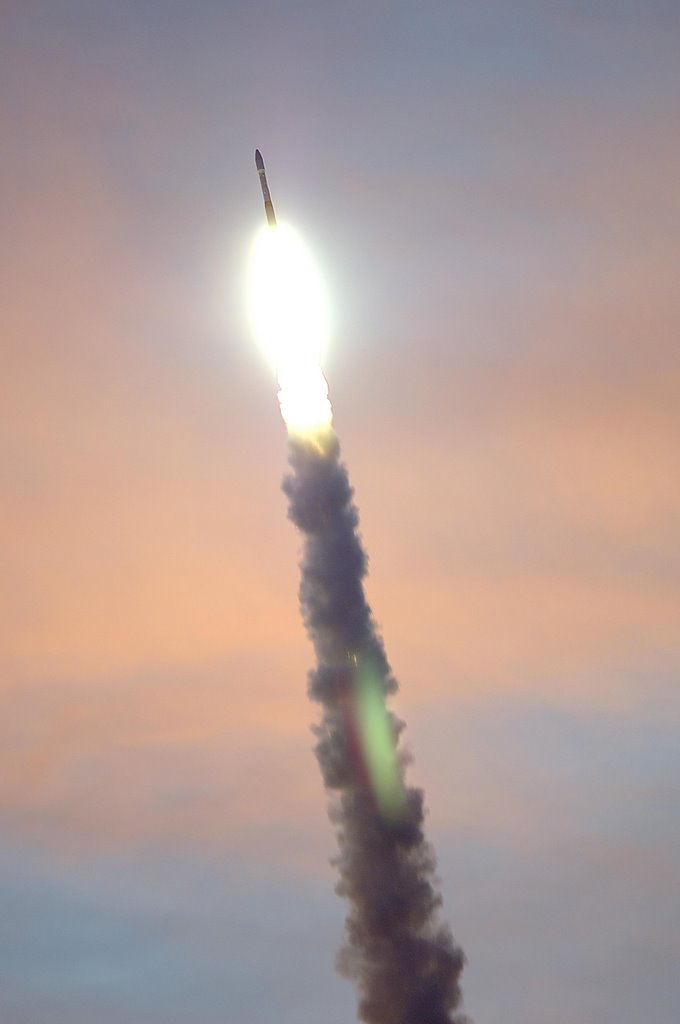
NASA
A sunrise launch this morning of a Minotaur rocket carrying two satellites inaugurated operations at the Mid-Atlantic Regional Spaceport (MARS) at NASA's Wallops Island facility on the Virginia coast. Growing operations at this spaceport, which may include space station resupply launches and suborbital tourist flights along with small to medium sized satellite launches, could be a boost to the Eastern Shore's economy and to the space industry of the whole Mid-Atlantic region.
I drove down late Friday afternoon and stayed overnight in nearby Pocomoke City, MD, rising early this morning to go out to the public viewing area on Assateague Island, a few miles from the launch site. The rocket was visible as a rising tongue of white flame with a trailing smoke plume which started to curl as the rocket arced high overhead and shed its first stage. One of the most impressive aspects of viewing a launch from a few miles away is how you hear no sound from the rising rocket for a number of seconds before the roaring sound reaches your location. The crowd gathered at the sandy beach site expressed awe and approval as the successful launch took place. This Virginian-Pilot article includes images from the Assateague Island viewing site.
Hanukkah and Our Attitude about the Future
(This is a post I originally made in 2003 and feel is worth repeating each year, especially in light of ongoing developments that could lead to human expansion into space that would provide resources for future generations.)
Rabbi Daniel Lapin has a provocative column in WorldNetDaily on a message of Hanukkah that is relevant to people of all faiths. He shows examples, ancient and modern, of how a pessimistic Malthusian worldview have been repeatedly disproved by the Creator's providence of material resources and the ingenuity to utilize them to provide for the future. Rabbi Lapin says:
(This is a post I originally made in 2003 and feel is worth repeating each year, especially in light of ongoing developments that could lead to human expansion into space that would provide resources for future generations.)
Rabbi Daniel Lapin has a provocative column in WorldNetDaily on a message of Hanukkah that is relevant to people of all faiths. He shows examples, ancient and modern, of how a pessimistic Malthusian worldview have been repeatedly disproved by the Creator's providence of material resources and the ingenuity to utilize them to provide for the future. Rabbi Lapin says:
It only seemed that we lacked sufficient copper, whale oil or wood. In reality, our God-given ingenuity developed exciting new technology that eliminated our need for each commodity just as it was becoming scarce.
Hanukkah's miracle was that, day after day, the Temple's menorah just kept on burning in spite of an apparent shortage of fuel - a metaphor, surely, for all apparent shortages that can be overcome with faith. Hanukkah invites us all to express gratitude to the Creator whose beneficence is boundless. It stimulates discussions that can spur our spiritual growth. It reminds us that with His gift of creativity, challenges become optimistic opportunities to partner with God in creatively solving all material shortage.
Saturday, December 09, 2006
Discovery Night Launch

NASA
The Space Shuttle Discovery lit up the skies over central Florida tonight when it lifted off on the STS-116 mission to the International Space Station (ISS). The SpaceflightNow.com article describes the importance of this mission for the continued assembly of ISS.
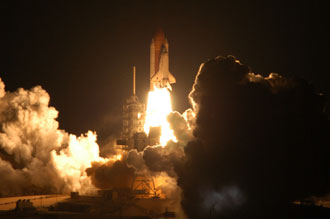
NASA
The Space Shuttle Discovery lit up the skies over central Florida tonight when it lifted off on the STS-116 mission to the International Space Station (ISS). The SpaceflightNow.com article describes the importance of this mission for the continued assembly of ISS.
Station construction has now reached the point where an interim power system, designed to support the station during its initial assembly, needs to be phased out. With the installation of new solar arrays in September, NASA is finally ready to activate the lab's permanent power grid, a major step that sets the stage for attachment of European and Japanese research modules.
Thursday, December 07, 2006
War Then and Now
With intense interest over this week's release of the Iraq Study Group (ISG) report, National Review Online commentators weigh in, and Victor Davis Hanson compares our nation's response to today's world threat to the response to the attack on Pearl Harbor 65 years ago today.
While I've only had time to read the ISG Executive Summary, I tend to think it is a mix of constructive and dubious recommendations and should be considered in combination with other sources, particularly our military, in reworking our strategy for Iraq in the context of the global situation.
With intense interest over this week's release of the Iraq Study Group (ISG) report, National Review Online commentators weigh in, and Victor Davis Hanson compares our nation's response to today's world threat to the response to the attack on Pearl Harbor 65 years ago today.
The limitations on our war-making are just as often self-imposed. Yes, we defeated the Axis powers in less than four years, but it was at a ghastly cost. To defeat both Japan and Germany, we averaged over 8,000 Americans lost every month of the war - compared to around 50 per month since Sept. 11.
So far the United States has encouraged its citizens to shop rather than sacrifice. The subtext is that we can defeat the terrorists and their autocratic sponsors with just a fraction of our available manpower - ensuring no real disruption in our lifestyles. That certainly wasn't the case with the Depression-era generation who fought World War II.
While I've only had time to read the ISG Executive Summary, I tend to think it is a mix of constructive and dubious recommendations and should be considered in combination with other sources, particularly our military, in reworking our strategy for Iraq in the context of the global situation.
Launch Scrub

Tonight's planned launch of the Shuttle Discovery on the STS-116 mission to the International Space Station (ISS) has been postponed due to weather. The weather does not look good the next few days, so the rescheduled launch date is TBD.

Tonight's planned launch of the Shuttle Discovery on the STS-116 mission to the International Space Station (ISS) has been postponed due to weather. The weather does not look good the next few days, so the rescheduled launch date is TBD.
Wednesday, December 06, 2006
Wet Mars?

A new gully deposit in a crater in the Centauri Montes Region.
Image credit: NASA/JPL/Malin Space Science Systems
NASA today announced that spacecraft imagery shows evidence that liquid water emerges on the surface of Mars before quickly evaporating or freezing.
UPDATE 12/7/06: SpaceToday.net links to several news stories about this significant announcement, and famed science fiction writer Ray Bradbury tells Fox News of his excitment about the Mars discovery and about NASA's lunar outpost plans.

A new gully deposit in a crater in the Centauri Montes Region.
Image credit: NASA/JPL/Malin Space Science Systems
NASA today announced that spacecraft imagery shows evidence that liquid water emerges on the surface of Mars before quickly evaporating or freezing.
Liquid water, as opposed to the water ice and water vapor known to exist at Mars, is considered necessary for life. The new findings heighten intrigue about the potential for microbial life on Mars. The Mars Orbiter Camera on NASA's Mars Global Surveyor provided the new evidence of the deposits in images taken in 2004 and 2005.
UPDATE 12/7/06: SpaceToday.net links to several news stories about this significant announcement, and famed science fiction writer Ray Bradbury tells Fox News of his excitment about the Mars discovery and about NASA's lunar outpost plans.
For decades, Bradbury has woven colorful science-fiction tales about people traveling to and living on Mars, many of them collected in his 1950 book "The Martian Chronicles."
His vivid descriptions of the planet have brought it to life for millions of readers, and he has long believed the stuff of his imagination would one day become reality.
"We're going to bring our life to Mars," he said. "We will be the Martians, and that's our future. I wish I were going to be alive the day we land on Mars and become the Martians."
Tuesday, December 05, 2006
A Strategy and Architecture for a Grand Vision
NASA yesterday announced a 'global strategy' and a 'lunar architecture' to define why we are going back to the Moon, what we will do there, and how we will do it.
More on the 'how' we explore the Moon.
SpaceToday.net has several links to reports on the announcement.
This post at HobbySpace.com links to several sources in the space community debating some of the specifics in NASA's architecture, particularly the launch systems. While there are differences over the details, what is shared is a vision of humans expanding into and settling in space. The National Space Society provides background on the vision of human space settlement.
NASA yesterday announced a 'global strategy' and a 'lunar architecture' to define why we are going back to the Moon, what we will do there, and how we will do it.
The Global Exploration Strategy focuses on two overarching issues: Why we are returning to the moon and what we plan to do when we get there. The strategy includes a comprehensive set of the reasons for embarking upon human and robotic exploration of the moon. NASA's proposed lunar architecture focuses on a third issue: How humans might accomplish the mission of exploring the moon.
More on the 'how' we explore the Moon.
NASA's Lunar Architecture Team, chartered in May 2006, concluded that the most advantageous approach is to develop a solar-powered lunar base and to locate it near one of the poles of the moon. With such an outpost, NASA can learn to use the Moon's natural resources to live off the land, make preparations for a journey to Mars, conduct a wide range of scientific investigations and encourage international participation.
SpaceToday.net has several links to reports on the announcement.
This post at HobbySpace.com links to several sources in the space community debating some of the specifics in NASA's architecture, particularly the launch systems. While there are differences over the details, what is shared is a vision of humans expanding into and settling in space. The National Space Society provides background on the vision of human space settlement.
Sunday, December 03, 2006
Catholic Science Fiction
I've recently been contacted by Karina Fabian, an author who writes science fiction which weaves in Catholic themes. For example, picture an order of nuns who live in space and perform search and rescue missions. Karina and her husband Rob are publishing an anthology of Catholic science fiction called Infinite Space, Infinite God. She also has a blog, FabianSpace.com.
I've been giving thought to the Church's role in the expanding frontier, and I believe this kind of literature is a tremendous way to explore this topic. I've only begun to explore these two fascinating sites. (I've also added the links to my sidebar.) I recommend you check them out too.
I've recently been contacted by Karina Fabian, an author who writes science fiction which weaves in Catholic themes. For example, picture an order of nuns who live in space and perform search and rescue missions. Karina and her husband Rob are publishing an anthology of Catholic science fiction called Infinite Space, Infinite God. She also has a blog, FabianSpace.com.
I've been giving thought to the Church's role in the expanding frontier, and I believe this kind of literature is a tremendous way to explore this topic. I've only begun to explore these two fascinating sites. (I've also added the links to my sidebar.) I recommend you check them out too.
Subscribe to:
Posts (Atom)